2008-01-10

Book Review 18: Star Trek Movie Memories


And now, with the fight scene in the can, and nothing else to distract me, I rode through the blackness of the night desert night into the neon haze of Las Vegas, back to my hotel, where I spent the night sleeplessly mourning the death of Captain James T. Kirk.

Page 348

This is a better book than Shatner's earlier memoir Star Trek Memories. The writing is tighter. The stories have more depth. And he spends less time quoting other cast members. We get the stories behind the films, and we learn why Star Trek: The Motion Picture was such a terrible film.

The writing team has improved. In the previous book, you could tell which paragraphs Shatner wrote and which paragraphs Kreski wrote. Don't worry though, Shatner is still Shatner and we still get gems like this:

My sleep became tortured., haunted by highly sensual dreams: pouty-lipped grilled cheese sandwiches beckoning me to dive into their rich, creamy goodness, voluptuous mounds of angel-hair pasta steaming for me and me alone, seaweed rolls busting out of their seams and driving me mad with their exotic Oriental beauty.

Page 71-72

NASA's calling. They need my help, fast. I spring into action immediately, jumping the first jet east. Six hours, three bags of peanuts and one truly horrendous chicken a la king meal later, I'm in Florida, where immediately upon landing I'm glad handed by a pair of aviator-sunglassed NASA representatives and shoved into a Jeep. I'm then shuttled off to Cape Canaveral , where I've been assigned the task of serving at the "surprise guest" at a party honoring one thousand of the agency's engineers . It's a difficult mission, one that could very well involve a lot of forced smiling, waving and schmoozing. Still, as any good captain can tell you, the needs of the many outweigh the needs of the few or the one, and with that in mind, I rise heroically to the occasion, sacrificing my personal comfort for the good of the United States space program.

Page 2

The difference is the writing flows smoothly from one paragraph to the next with no jarring change of tone. Shatner and Kreski became an actual team.

The book begins with Paramount cancelling the Star Trek TV series. Then it follows Shatner through some of the darkest time in his life. He got divorced at the end of season 3, and suddenly was living by himself with no job.

I learned that there's nothing more disheartening than the luxury of forced free time.

Page 7

Eventually he starts working again for a touring theater company. He's broke, so he lives with his dog in a camper on the back of his pick up truck. And he toured the east coast doing plays for a summer.

I have now survived a one-hundred-day sentence in purgatory, with no exit from a shallow, transitory, empty place, wherein your entire life is kept at arm's length, where you work all the time because you simply have nothing else, where business acquaintances have to pass for friends. It's not an unpleasant world, it's merely devoid of any real human contact, devoid of passion. It's a place where everybody likes you, but nobody loves you.

Page 14

The book then moves on to the movies, giving each film from Star Trek: The Motion Picture to Star Trek: Generations its own chapter.

The production of what had now been officially entitled Star Trek: The Motion Picture continued like the tortoise, slow, but…well, slow anyway.

Page 93

One of the most interesting aspects of the book is how the authors dissect the cinematic disaster that was Star Trek: The Motion Picture. It's a beautiful movie but extremely boring. Gene Rodenberry created Star Trek as a Wagon Train to the stars – an exciting western type show. And yet, he took a talented group of actors, a rich and exciting Star Trek universe, an effects budget they could only have dreamed of in the TV days, and somehow made science fiction and the impending destruction of Earth boring. It was an incredible way to squander the francise.

For the second film, Paramount knew better and the tried to keep Rodenberry as far away from the movies as their contract would permit.

Eisner, however, was taking no chances this time around. Robert Wise, as talented as he is, wasn't offered the director's chair. Gene Rodenberry, whose contract bade such banishment, was eventually kicked upstairs and given the largely ceremonial title of "executive consultant." Paid handsomely and allowed to comment on every story idea and scripted draft of the sequel, Gene was nonetheless stripped of his formerly ironclad "top dog" status.

Page 99

Harve Bennet, who would go on to produce most of the early Star Trek movies, came to the francise without having seen most of the TV series. So he began studying it. Finally he decided Star Trek II would be a sequel not to the first movie, but to an episode of the TV series.

Hence, I was stuck with the following problem: "Why was I so bored by Star Trek: The Motion Picture, which was skillfully manufactured and beautiful tale?" I began to analyze it and realized that the film wasn't really Star Trek at all. It was more of a tone poem, a think piece about God, a very religious essay about the ironies of V'ger returning to search for its creator. The action and the characters that had always been the foundation of the very best Star Trek episodes were really just along for the ride, shoehorned into a story in an attempt to make this rich philosophical disputation seem more like a large-scale adventure story

Page 103

Second, "Space Seed had a clear, ballsy, theatrical antagonist, which I felt was almost always present in the best episodes of Star Trek, and missing from The Motion Picture. There, V'ger ultimately shaped up to be more of a misguided spiritual force than a clear-cut antagonist. So I knew we needed a black-hat villan whose reasons for being a villan were clearly defined and motivated. I wanted a classic tale of vengeance, a real "revenge is the best revenge" kind of story.

Page 105

Rodenberry had forgotten what Star Trek was really about.

Fans of the TV show Star Trek: The Next Generation may see some parallels here. Rodenberry was directly involved in the first season of the show. He made it beautiful. He tried to make it philosophical. How does he do this? He gives us a pilot episode about two space jelly fish in love. He badly rehashes an episode from the original series where people lose their self control. Except in this show, instead of Spock breaking down in tears over his deep human-vulcan identity, or Sulu running around with a sword, we have a security chief who has sex with a robot. Later on that same season he kills off the security chief. She dies when a pool of tar kills her. Why does it kill her? Because it can. It's mean and angry that people keep leaving it.

Eventually Rodenberry got yanked from the day-to-day activities of the new TV show as well. TNG caught its stride and eventually gave us the Borg and Locutus story lines. And, of course, the brilliant Inner Light episode.

Rodenberry got pushed further away from the movies. Nick Meyer, who basically wrote the screen play for Star Trek III: The Search for Spock had this to say:

This Star Trek was much more militaristic than Gene's. He was a utopian, he believed in the perfectibility of man. I don't. That always put me at odds with Gene, but as far as I was concerned, except for Star Trek: The Motion Picture, Gene was never really involved in the movies. You'd just go in and meet with him and then get to work….Star Trek: The Motion Picture was his creation and that he was responsible for taking it up a wrong path someplace. So what I had, rightly or wrongly, was a very clear vision of what I wanted, and the freedom to make it happen. So I made Captain Hornblower in outer space, an adventure movie that was about friendship, old age, and death.

Page 130

Rodenberry was also obsessed with President Kennedy. Almost every time they made another movie, Rodenberry wanted them to get involved in the JKF assassination.

Gene didn't like the script for Star Trek III at all, and he practically burst a blood vessel railing against Harve's plan to whack the Enterprise. Again, as he had done on Khan, Rodenberry proposed dumping Bennet's script in favor of his own (now slightly revised) time-travelling story in which the Enterprise ends up back in the early sixties mixing and mingling with …you guessed it, John F. Kennedy. This time it would seem, the climactic moments of the film would find Spock, standing on a grassy knoll in Dallas, firing that infamous "phantom shot" as a way of ensuring Kennedy's death and thereby guaranteeing a brighter future for all of mankind.

Page 161-162

Shatner and Kreski continue these behind the scenes discussions and analyses about all the movies throughout the book.

While Star Trek: The Motion Picture may be the worst Star Trek Movie, Star Trek V: The Final Fronteir isn't far behind. You can hear us dissect this movie in the Play Cole Podcasts.

The Final Frontier was Shatner's baby. He conceived it, worked on the script, ordered the effects, and, of course, directed it.

Why on Earth would the studio let Shatner direct a movie? They had to. Years before, Leonard Nimoy and Shatner created a most favored nation clause in their contracts. Anything offered to one, had to be offered to the other. Nimoy did a great job as director on Star Trek III and IV. So now it was Shatner's turn.

Shatner concedes the movie is not good. He says the reason it was bad (beside the fact that he couldn't have 30 Rock Men) at the end, is because the scrip revisions process and budgeting restrictions destroyed the story. The end and the journey itself were completely changed and compromised from what Shatner envisioned.

Shatner takes us through his original vision and story line to prove his point. I didn't think it was possible, but his original version would have been worse. It was a terrible story intended to be a commentary on God, angels, demons, and hubris. Kirk would have been the only one in the story who wasn't an idiot.

Instead of making a truly awful movie, they made one that is merely terrible.

I was a little disappointed that Shatner didn't mention his daughter Liz in the chapter about this movie. Liz Shatner if prominently featured on Shatner's audio commentary about the movie. She knew more about the film than he did. Se deserved a mention in this chapter.

The is one of the best books I've read this year. While Shatner's first book was good, Star Trek Movie Memories takes the story to another level entirely. Granted, the material in this book is fresher to Shatner and should be more detailed. But it's more than that. This book isn't just a collection of fun stories painting simple caricatures of the actors and film makers. We get to know the characters. Shatner and Kreski go not for the anecdotes, but for the stories. Some people come off well (Harve Bennet, Nick Meyer, George Takei, Deforrest Kelly). Some come off poorly (Shatner's best friend Leonard Nimoy, Gene Rodenberry).

Shatner and Kreski put together a brilliant history of the Star Trek movies. It's detailed, insightful, and well told. And it never loses that iconic Shatner wackiness.


Tomorrow: I Am Spock, by Leonard Nimoy

2008-01-09

Book Review 17: The Longest Trek


Finally, in the summer of 1966, on stage 9 at Desilu Studios, I was home. I belonged. I was Yeoman Janice Rand, I had a character of my own to explore and develop, week after week. I was part of something wonderful and exciting, something called Star Trek.

I had no idea how soon it would all be ripped away from me.

Page 1

Grace Lee Whitney played Yeoman Janice Rand for half of Star Trek's first season. Then her character just disappeared from the show with no explanation. This book is her story.

Whitney is a recovering alcoholic, and that fact is never far from the reader's mind.

She talks about growing up as an adopted child, her early movie and singing career in the 50s and 60s, her time on Star Trek, her deeper decent into alcohol, drugs and sex, how she began her recovery and finally was born again.

It's a fascinating story, but not primarily a Star Trek one. While Star Trek is rarely far from the narrative, Whitney's story could be about any wildly successful show.

This is also not a happy memoir. The entire book follows the structure of the opening quote. Whitney talks about a part of her life, a movie she was in, friends she had, etc. After a couple pages of that, when the reader is caught up in the narrative, Whitney's alcoholism pops up to assert its role in her story. After a few stories like this, I knew the alcoholism was waiting in the background for the proper moment to pop out and break any illusion that Whitney's life was going well.

I believe that's an intentional structure. And it's a powerful way to keep reader interested. The book doesn't have wide sections of Whitney talking about just alcohol, pills and sex addictions. Instead, the stories of her life provide the context to understand the insidious nature of her addictions.

Whiteny doesn't waste any time in getting to the challenges she faced. In the first chapter explains that an executive involved with the show lured her away from a wrap party after they finished filming an episode. He wanted to talk to her about the direction her character was going, and how they could expand the role of Yeoman Rand aboard the Enterprise. They went to an empty studio building and into an office suite. Then Executive locked they door and assaulted her when she refused his advances.


I went through the rest of the day with a sinking feeling that I had shot myself in the foot – no, in both feet. Getting ahead in Hollywood is often a matter of knowing who holds the power, then finding a way to get close to that power, and even in bed with that power. I had refused to get close to that power. It might have been the morally defensible choice –but it was tactically stupid, in terms of my career. Inwardly, I kicked myself for not playing along, because in the end I was just as violated and exploited by this man as if I had – yet I had no career advancement to show for it. Bad move, Whitney, I thought. You've done it to yourself again.

Page 8

We don't know who The Executive is. Whitney chooses not to name him.

A number of years ago, I was offered a considerable sum of money by a major New York publisher to write a book and tell this story – if I would publicly name the man who did this to me. I refused to do that. It wasn't because I was so noble and wanted to protect him. The fact is, there were two reasons I refused to name him. One, I am a recovering an alcoholic, and in order to keep my sobriety, I must take a continual, day-to-day moral inventory of myself, and I must make amends to all the person I have harmed – even those who hurt me. I must not harm others. So I refused to hurt this man or his reputation. And two, I was afraid of him and what he might do to me.


Today, The Executive can no longer hurt me—but I still refuse to name him. This book is my story, not his. Naturally, I can't tell my story without disclosing some of my interaction with other people—but I'm not going to tell anyone else's story or damage anyone else's reputation. Ask me about my life and my story, and I'll be happy to share it all with you. Ask me the identity of The Executive, I will not answer you. So please respect my wishes. Don't ask.

Page 14

Whitney did not want to leave Star Trek, yet was fired several days later. There are several possible reasons she was fired.

  1. The Executive punished her because she refused his advances.
  2. The powers that be made a creative decision that character's presence on board the ship interfered with the direction they wanted to take Kirk's character.
  3. Whitney's alcohol and drug use interfered with the production.

I don't believe Whitney actually says she was fired for reason 1, but she certainly implies it though out the book. Given the timing it seems likely, though.

The powers that be told Whitney's agent they were firing her for reason number 2.

"Well," Alex explained, "I'm told it's a creative decision. The producers feel the romantic relationship between Kirk and Rand is becoming too obvious, and it limits the story possibilities. Apparently, they think Captain Kirk needs to be free to have affairs with other women on all these different planets. If the relationship between Kirk and Rand is too intense, it looks like he's tow-timing Janice Rand. The viewers will get mad at Kirk and tine out. At least, that's what they tell me."

Page 9

This is an interesting possibility, given the original intent of Whitney's character.

Yeoman Rand was intended to be a romantic interest for Captain Kirk. They wouldn't actually be involved with one another, but the simmering romantic potential would always exist beneath the surface. When he designed the roles, Gene Rodenberry had "Gunsmoke" in mind. He intended for Rand to be the Miss Kitty to Kirk's Marshall Dillon.

Until I started reading these books, (Shatner and Nimoy also discuss this role of Whitney's character) I had no idea Rand was Kirk's love interest. While the creators hinted at the relationship in early episodes, it wasn't readily apparent in syndication. I started watching Star Trek in mid-seventies when it aired in syndication. Since the episodes were often out of order, Rand appeared seemingly at random, and not as a major character.

And I was 8 at the time.

Regardless, this appears to be a reasonable explanation for Whitney's departure from the cast. The timing makes it suspicious, however. Additionally, Whitney report an odd conversation she had with Rodenberry several year later:


Gene and I talked about my removal from the original series, and he told me it was the biggest mistake he ever made. He blamed the decisions on the network, claiming that the edict to remove me came from NBC. Supposedly, the network had wanted Captain Kirk to be unencumbered by a girlfriend back on the ship as he went from world to world, leaving a trail of broken hearts in his wake. I believed him then, though I've since learned that it was typically Gene's pattern to use the "evil network" as a scapegoat. The fact is that Gene could have put his foot down and kept me aboard, but he didn't do so – and he later apologized to me for it. That's all that counts.

Page 131

The third possible reason Whitney was fired was the impact of drugs and alcohol on her performance. This the reason Shatner cited in Star Trek Memories, and Whitney quotes Shatner for her book.

In his book Star Trek Memories, William Shatner and his co-writer, Chris Kreski talk aobut the diet pills I took and the fact that I sometimes drank to take the edge off the nervousness caused by the amphetamines. That much of my story is exactly as I related it to them in our phone interview, and as I related it here in this book. But after that point, inaccuracies and misinterpretations begin to compound themselves in Bill's version of my story. He writes:

Even during our first few weeks of production, Grace had become noticeably distracter, visibly ill, and as a result her performance suffered terribly. By the time we were filming our tenth episode ["What are Little Girls Made Of?"], Grace's condition had worsened to the point where here scenes were consciously being given to other characters or completely written out of episodes. For example, Grace was to have costarred with Captain Kirk in our eleventh episode, "Dagger of the mind," but her deterioration forced Rodenberry and Justman into a decision to rewrite the episode, adding the guest character of Dr. Helen Noel and entirely deleting Yeoman Rand. Further, in Grace's final episode, "the Conscience of the Kin," her performance consisted solely of walking onto the bridge in the background of the scene, taking a quick look at a particular piece of equipment, then exiting. She was let go the following day.

Page 101-102

Whitney then spends several pages disputing Shatner's comments. She acknowledges drinking at the time, but argues she was never drunk on the set, and kept her dinking confined to time she was off the set.

Whitney did start taking pills because of the show:

Right at the beginning, when I went in to be fitted for my uniform, Bill Theiss, the costume designer, said to me, "Grace, you're a little overweight. You really have to slim down a bit, or the costume won't look right. Why don't you call your doctor and have him give you some pills?"

Page 86

She continues to assert that her alcoholism did not impact her performance on the show.

Regardless of why she was fired, it turned her world upside down.

Finally, I had what I wanted: a continuing role on a weekly series. It meant fame, money, security – and not just career security, but the kind of emotional security I had been searching for ever since I learned I was adopted. I felt accepted. I felt beautiful and wanted. I felt chose. Finally, I was home – home aboard the Starship Enterprise.

Page 72

And suddenly she was out.

Whitney's closest friend in the cast was the much maligned Leonard Nimoy.

The one person who really reached out to me after I was written out of Star Trek was Leonard Nimoy. He was the only one who really knew how much I was hurting. No one but Leonard knew what had happened to me that horrible Friday night after the wrap party.

Page 12

Leonard is the exact opposite of the emotionless alien he played. While Mr. Spock is mysterious, cool and smugly logical, Leonard Nimoy is sensitive, vulnerable, and attuned to the feelings of those around him. As an actor, he is the complete professional. He always cares about the character, the show, the quality of the performance. He's not interested in one-upping the other actors.

Page 83

Despite Shatner's comments about Whitney in his own book, Whitney goes out of her way to defend Shatner.

William Shatner has been criticized by some of his fellow cast members for being self-absorbed and inconsiderate on the set of Star Trek. In Bill's defense, there was a lot going on in his life. I remember him as being very sad and withdrawn during those early weeks of shooting. His father was dying at that the time, his marriage was breaking up, and he obviously loved his two little girls and wanted to be a good dad to them, no matter what happened to his marriage. H didn't seem to have close friends to confide in, and he was under a lot of stress as the star of a network series. I suppose Bill was self-absorbed during that time – but given the way his life was disintegrating, I can't hold that against him. The wonder of William Shatner is that, with so much going on in his off-screen life, he was so engaging and commanding on-screen.

Page 83

Whitney also admires Shatner for his acting knowledge. No, I'm not kidding. He stuck around the set to help her film a scene of "The Enemy Within."

We had to shoot the rape scene a day or two earlier; and sometimes it's hard to get back into the emotions of a previously shot scene when some time has passed. Bill just knew that a surprise slap across the face would put me right back in that frame of mind, that painful sense of having just been violated by the captain. He knew that it would provide just the right emotional impact to motivate me to do the scene. As a result, I have a terrific performance in a single take.

Page 94

Whitney doesn't just tell Star Trek stories, though. She greatly admired Phil Silvers for his energy when she acted with him.

Phil Silvers was one of the greatest comedic performers of all time, and it was fascinating to watch him prepare for a performance. As he waited for the curtain to rise, he would paste furiously, back and forth, for at least 15 to 20 minutes. He was getting up a big head of steam, building up energy and momentum, so that when he came out on stage, he would burst onto the stage with blazing energy. That was the secret to the vibrant performances he gave. I never saw another actor prepare himself to go on the way Phil Silvers did.

Page 33

Whitney also tells some great stories about working on the set with Marilyn Monroe.

A lot of the learning experience was fun, too – luxuriating in the beautiful surroundings , the beach, the yacht, the beautiful clothes, watching Jack and Tony walking around in women's clothing, being continually awed by the on-screen chemistry between Tony and Marilyn – and watching the chemistry dissolve into off-screen loathing as soon as Billy yelled, "Cut!" Tony later said that his love scenes with Marilyn were "like kissing Hitler."

Pave 44

Whitney even appeared in the King Tut episodes of Batman.

Shortly before joining the cast of Star Trek, I appeared in a two-part episode of the campy cult classic, "Batman," shot at Twentieth Century-Fox. The two-part episode is entitled "King Tut's Coup" and "Batman's Waterloo." King Tut was played by my friend Victor Buono, one of the sweetest men I've ever known. I played Princess Neela, one of King Tut's concubines. Lee Meriwether appeared in the show as an heiress who is kidnapped by Tut to be his unwilling Queen of the Nile (she later appeared in a Trek episode, "That Which Survives").

I didn't have many scenes with Adam West (Batman), but we talked a lot on the set, having known each other from our days together at Warner Brothers. He was another one of those gorgeous Hollywood men I was extremely attracted to. Though I never got involved with Adam, I was always aware of powerful sexual electricity on the set.

Page 68-69

Even when she's telling Hollywood stories, Whitney's stories all come back to the impact of alcohol and drugs.

When Arthur Miller left her, he said he couldn't live with her anymore because she was so self-obsessed, so demanding. When she was around him, he couldn't work, he practically couldn't breather. I know what he meant, because I did the same thing to the men in my life. That's what alcoholics do. We don't have relationships, we take hostages. We're so involved with ourselves, so needy and demanding of attention, that no one can be with us.

Page 46

Whitney did the same thing in her own relationships.

I was also attracted to Steve because he didn't drink. I drank all the time, but Steve was an abstainer. I thought, Maybe if I marry him I'll stop drinking. I'll be a good girl. I saw myself as bad, but I really wanted to be good. I thought a nice Jewish boy would help me to be a good Jewish girl.

Page 34

I blame myself, not Steve, for he divorce. I thinks he really meant to do right by our marriage, but I was a very difficult to live with. I could list a lot of Steve's flaws, but why? I was the alcoholic, not him. If he was hard to live with, I was even more so. He was not an abuser. He was good to the kids when we were together. He was even kind to my parents; he treated them with respect. So, looking back, I have to shoulder most of the blame for our failed marriage.

Page 88

I call my time with Harlan my "cookies and milk days." Always with Harlan, it was Oreos and milk, or Oreos and ice cream. I always wanted a drink, but Harlan would screw up his face and say, "How can you drink that stuff? Alcohol tastes terrible! Worse than medicine! Here, have another cookie."

When he'd say things like that, I would look at him like he was crazy! I couldn't see how anyone could have a good time without a drink! At the same time, I found Harlan's abstinence very attractive. I was initially attracted to that same quality in my first husband. When I dated Harlan, I had the same idea aobut him that I did about Steve: Maybe if I marry him, I'll stop drinking. I'll be a good Jewish girl. I saw Harlan Ellison another nice Jewish boy who could help me to be good.

Page 114

In 1970 and '71, I made some big changes in my life. I took another hostage. I married a base player named Jack….I also put the plug in the jug and stopped drinking. Was I finally clean and sober? Hardly. I just switched from drinking to smoking dope. It's called "switching seats on the Titanic." I stopped drinking but I didn't get sober – I only switched addictions. I was a dry drunk. I avoided alcohol and only smoked marijuana for the next eight years or so. I used to roll joints that were as thick as cigars, trying to get as high on week as I used to get on the bottle.

Page 119

Whitney tells more stories from her life and how they were impacted by alcohol. She doesn't glamorize it. And she takes responsibility for actions. At the same time, she frames everything in the context of her addiction.

The alcoholic mind is insidious. I've been plagued by that kind of mind all my lifew. Even before I drank, I had an alcoholic mind. Alcohol is only a symptom of the real disease. The "ism" of alcoholism runs much deeper than alcohol alone.

Page 121

Ultimately the alcohol, drug, and sex addictions nearly killed her.

Around the beginning of 1981, I left the guy I was living with, then moved to my mother's house for a while, then went back home to Jack for a few weeks and tried desperately to put my life back in order. I was hoping Jack would forgive me and I could start over and start living right. But by the that time, I couldn't stop drinking. The hell of it was that I drank and drank, but I couldn't get drunk anymore. But if I stopped drinking, I couldn't get sober. I couldn't clear my head. When an alcoholic drinks but can't get drunk, or stops but can't get sober, then that is the end of the line, one way or another. There is no way out if you get to this point and can't get sober. You either go insane from a wet brain, end up in prison, or kill yourself.

Page 144

Whitney, who had converted to Judaism for her first marriage ultimately began her recovery after attending a 12 Step program and becoming "Born Again." She spends some time talking about he religious conversion, but it is really about sharing her experience. She doesn't get preachy, which keeps the latter part of the book accessible.

Later on, while travelling in Israel for her son's Bar Mitzvah, she has a vision:

Then I saw Jesus.

He was beyond the iron bars, praying in the garden [of Gethsemane]. His appearance was neither as solid and three-dimensional as reality, nor as unreal and insubstantial as a dream. It was more like an inner reality, something that seemed completely real, but real within me – not objectively, externally real.

Page 156

She goes to great pains to explain that Christ did not appear in the physical sense. She is well aware that no one else would be able to see what she did.

She tells her conversion story well. She uses it to talk about her life, her recovery, and how she liver her life now. She doesn't use it as a call for conversion or for evangelical purposes. It's a good balance for the book.

That's not to say she hides her faith or appears ashamed of it. She actually spends several pages discussing Gene Rodenberry's atheism and the spiritual undercurrents in Star Trek.


Even if it is true, as such creations as Nomad, V'Ger, and Questor suggest, that some hidden part of Gene wished and longed for God, he seemed unable to get past the notion of biblical faith as a refuge for the ignorant and uneducated. Gene was profoundly annoyed by evangelicals and fundamentalists.

Page 176

Whitney's story would make a good Lifetime movie -- and I mean that in the best possible way. Her tale of mid-west girl goes to Hollywood is engaging. She tells the story of her addiction and recovery with neither romanticism nor bitterness. It's a cautionary and real world tale of how someone can function up to a certain point with the lifelong disease of alcoholism.

The writing itself is good. The story jumps around a bit in her personal timeline, but for the most part it's still easy to follow. She skips over much of the 70s in her book, which I thought was odd choice. But given that instead of alcohol, her addictions then were mainly sex and drugs, she likely did it to make sure the book didn't get overshadowed by sex.

There are too many exclamation points in the book for my taste, but that's a personal pet peeve of mine.

If you have primarily interested in the history of Star Trek, this book probably shouldn't be at the top of your list. Nimoy and Shatner go into much greater detail about the show and movies. This book is Whitney's story.

If you are interested in a story of addiction and recovery, or the story of a Hollywood starlet who may have drunk herself out of being a major star, then this is a good book to read. It's not a happy book; it's not light reading. But in the end it's worthwhile.

Tomorrow: Star Trek Movie Memories, by William Shatner

2008-01-08

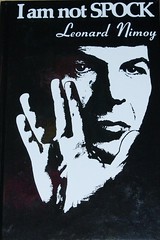
Book Review 16: I am not SPOCK


Right or wrong, drama for me is a kind of spiritual crusade.

Page 110

Leonard Nimoy's first memoir is a meditation on the identity crisis he suffers in the years following Star Trek. Writing in the early 70s, Nimoy uses the book to try to understand where Spock ends and Nimoy begins. When he's not discussing the internal struggle he faces, he tells us stories about some of his Star Trek struggles, what it means to be an actor, and what he did in the post Star Trek years.

To begin with, this is a great smelling book. It has that strong, fresh paper scent that you typically don't see with newly published books these days. Perhaps in the past two decades publishers have eliminated some of the chemicals that used to make books smell like that. And, like the old, purple mimeograph documents, the classic scent of books is gradually disappearing.

Nimoy wrote the book while Star Trek was still a cult show. The convention business was growing, and the show was just beginning to take off in syndication. The book came out several years before the first Star Trek movie, and even before Star Wars transformed the science fiction adventure movie. Nimoy was trying to build an acting career while being known mainly as the guy with the funny ears.

There seems to be a commonly held perception that Nimoy was angry at the way Spock overshadowed Nimoy's other characters. And the book title seems to encourage that perception. Nimoy's relationship with Spock is more complex and is the heart of the book.

The first lines in the book emphasize the close relationship Nimoy has with his most famous character.

I don't go around introducing myself to strangers as Mr. Spock. But when someone addresses a letter to "Mr. Spock, Hollywood, California," I'm the one who gets it.

Page 1

In the second chapter, also called "I am not Spock," Nimoy dives into the contrast between Spock and other aspects of his life. It's an exploration of character that is less of a TV Script and more of a personal roommate. Spock may be fiction -- just words on the page. But to Nimoy, he is a separate entity. Nimoy "talks" to Spock, lives with him, consults him, and treats him as a separate person. Nimoy is not crazy; he understands the fiction involved. But the phenomenal presence Spock has in pop culture means that Spock will always be more than ink on a page.

I have a brother, Melvin. He lives 3,000 miles away. We have a good relationship. But it's different. If someone compliments him, I take pride. If someone were malign him, I would be hurt. But he is he. I am not him and he is not me. We exist independently. Spock and I do not. So, Spock is not my brother.

Page 13

I am not Spock.

But given the choice, if I had to be someone else, I would be Spock. If someone said, "You can have the choice of being any other TV Character ever played," I would choose Spock. I like him. I admire him. I respect him….He stand for something that makes me feel good. Dignity and honesty and a lot more. And whatever of that rubs off on me makes me feel good.

But I am not Spock.

Page 17

Later on, Nimoy talks about a speech he gave at a 1973 Star Trek convention. He comments on stories that he wanted to distance himself from his work on Star Trek.

"The whole concept was to create a believable environment in spite of some of the pretty fantastic things that were going to take place on the show. Therefore, I can not, never have, and never will complain about identification with the character. To begin with, because I feel that if that identification has taken place, I believe I've done my job as an actor, and second, because the character is perhaps the most dignified, most intelligent, most meaningful and most challenging character that I will ever get to play in my life and I'm very proud of it!"

That was the truth, but it wasn't really that simple.

Page 60

Nimoy is an intelligent guy and realized that even if he wanted to shed his Spock association, he really couldn't.

There were a lot of emotional cross currents operating for me at this time. Obviously, the work being offered was coming as a direct result of my impact as Mr. Spock. On the other hand, I was involved in something of a crusade to develop a reputation as an actor with some range.

At this point, I went through a definite identity crisis. The questions was whether to embrace Mr. Spock or to fight the onslaught of public interest. I realize now that I really had no choice in the matter. Spock and Star Trek were very much alive and there wasn't anything I could do to change that.

Page 63

In Shatner's books, Nimoy could come off as bit of jerk. And yet Shatner constantly referred to Nimoy as his best friend, and seemed to hold him in high regard. But Nimoy was always demanding things from the studio or arguing about Spock's role with Rodenberry or the other writers and producers. At first glance, it appeared Nimoy wanted more attention and more screen time. But I don't think that was Shatner's intention. On closer inspection, though, it appears Nimoy was really concerned more about Spock and less about Nimoy.

In his own book, Nimoy tells some of the those same stories. And it is clear that he takes his roles seriously -- perhaps more seriously than any other actor on the show. Nimoy is not just there to read Spock's lines, but to become Spock. Nimoy takes the script and builds on the persona. He commits to the part as though it were a true drama, and not just a mere TV show.

In a sense, Shatner is Kirk. Kirk seems to be just an exaggerated or idealized version of Shatner. It seems there is less pure acting there. I can't picture Shatner and Kirk together in the same room

Nimoy's relationship to his role is more complex. I can picture Nimoy and Spock in the same room. Rather than just putting on the ears and eyebrows and taking direction, Nimoy practically grows the ears and eybrows and gives life to Spock. Nimoy talks about his approach to acting early on.

The approach to the teaching was heavily influences by the concepts of Stanislavski. In my case, I was particularly committed to the concepts he expressed in Building a Character." I am very much affected by the clothes I wear. Putting on a cap can make me feel quite dashing and romantic. An old work jacket, work boots and an old dirty cap can make me feel quite seedy. The character clothes begin to affect me inwardly, as does the make-up. There are various other elements which will lead me to the core of the character. But the externals to me are very helpful.

Page 7

There are few externals as closely linked to a characters and Spock's.

Following Star Trek Nimoy looked for other parts. He even played McMurphy in a stage production of One Flew Over the Cuckoos nest. I'm still trying to wrap my head around the idea of Nimoy playing the same character that Jack Nicholson would come to define a few years later.

…I chose to do a play called: One Flew Over the Cuckoo's Nest – to play McMurphy, because it there's anybody that's different from Spock, it's McMurphy. Because he's a totally instinctual, gut-level reactive anti-intellectual character, as opposed to Spock who is a thinker.

Page 65-66

It was an effort not distance himself from Spock for the public's benefit, but to exercise his own acting skills. That's been the continuing challenge for Nimoy.

After Star Trek, he became a cast member on Mission: Impossible. Eventually, though, he got bored with the variety of characters he was playing there. He acccomplished all he felt he could accomplish on that show, and asked to get out of his contract early.

Had I stayed on the show for at least the two additional years of my contract, and possibly the third year to the end of the series, I would have repeated myself professionally, and made an awful lot of money. The difference would be that instead of being a rich man today, I guess I would have been a very rich man today.

Page 117

At this point it's also interesting to compare him to Shatner. While Nimoy jumped on to Mission: Impossible with a lucrative contract, Shatner was doing regional theater and living in the back of his truck. Their professional careers had taken different directions.

It seems that every role Nimoy took, he took seriously. He gives his all and does whatever he can to make any production he's in the best it can possibly be.

The Acting is more important than the actor, and it should be treated as such. Performing a role properly and fully is almost a religious experience and obligation.

For the next few minutes, twenty five of the most beautiful singers, actors and dancers that it will ever be my privilege to work with, were huddled in tearful joy. That night's audience who watched the performance of Fiddler on the Roof were treated to a holy communion of the human spirit.

Page 132

And people who are that commited to something will appear arrogant and self centered, even though they aren't . The kind of commitment means they fight for what they believe is right, regardless of the egos they may bruise. They have a higher purpose, and that is to get it right.

Nimoy does tell a few Star Trek stories, such as the creation of his ears, the birth of the Vulcan neck pinch, and the development with the Rand and Chapel characters.

In the first several episodes, the character of Yeoman Rand, played by Grace Lee Whitney, was the direct counterpart to Amanda Blake's "Kitty," the silent, secret love of the leading man. This proved to be clumsy on Star Trek. It limited Captain Kirk's potential relationships with other ladies since he would have seemed unfaithful to Miss Rand. She was eliminated to give the amorous Captain more lebensraum.

Ironically, the opposite pattern developed in the case of Spock. Although he was theoretically incapable of loving, the female audience notified us very quickly that he was very much loved. This led to the introduction of the" Nurse Chapel" character, played by Majel Barrett.

It was through her character that the female audience could express itself. It was she who worried about Mr. Spock and cooked soup for him. It was she who cared about and quietly loved the Vulcan who couldn't respond.

Page 40

The book is short -- just 138 pages. But it could use a stronger hand at the editor's pen. Nimoy often jumps from topic to topic with little transition. Then he comes back to his original topic. It's as if he is spiraling in a point . This particularly evident in chapter 1, but continues throughout the book.

At one point, he talks about why Star Trek was cancelled.

There is a terrible, prevalent misconception that Star Trek was cancelled because it was too costly to produce. This is not the case. The show was run a very average budget. Mission: Impossible which was shooting next door on the Paramount lot was costing approximately 25% more than Star Trek.

Page 38

The he goes on to a bigger discussion of Mission: Impossible and the Star Trek schedule. He doesn't actually come back to why the show was cancelled.

Most of chapter 9 is about his favorite episodes. He talks about why he liked them and what they meant for the characters.

Then he suddenly jumps out of the episode discussion and talks about how the transporters worked. It's great information, but without any sort of transition, it was out of place.

I am not SPOCK captures Nimoy's thoughts at an interesting time. Star Trek was a cult, but was just starting to grow its monstrous following. There were no movies yet, and those discussions were still years away. Nimoy was fresh out of the series and didn't know he would still be putting on the ears 20 years later.

Despite the way the text jumps around, this is a fascinating look at the actor and the character. If you are more interested in an entertaining history of Star Trek, read Shatner's book. But if you are interested in a deep exploration of becoming a character, or you just want know more about the relationship between Nimoy and Spock, this is a great gooks to read.

And if you've made it this far, here is one more thought from Nimoy.

Most people are so busy doing what they must do that they never have the opportunity to find out what they can do.

Page 118


Tomorrow: The Longest Trek, by Grace Lee Whitney

2008-01-07

Book Review 15: Star Trek Memories


If you don't like William Shatner, you may as well skip this book.

But if you enjoy Shatner being Shatner, you owe it to yourself to read Star Trek memories This is how the first chapter begins:

Snoring, smiling broadly, I am secure in the warmth and comfort of a carefree, dreamless sleep, and then it hits.

Instantly, my peace is shattered by the brain-piercing electronic screeching that blares and buzzes from my evil digital alarm clock. Quickly, I spring into action, tossing about heroically and finally employing the desperate maneuver known as the old "pillow over the ears" trick. Nothing works, and I come to realize this is truly a no-win situation…in Trekker an early morning kobayashi Maru. Slowly, painfully, my eyelids begin to slide upward, and my semiconscious senses begin to contemplate the orangy-red block-style numbers that glare and blink at me, just out of reach, mocking my early morning helplessness. Their blurry taunts immediately tell me that my eyesight isn't what it used to be, and, upon squinting, that it's also 5:15 AM. I'm late.

…

Now I boldly go…into the bathroom, stumbling to the sink, where a sting of cold tile and a splash of cold water shock me at both extremities. The cobwebs finally begin to dissipate. I find my toothbrush, and in my nearly awakened state, I even manage to load it up. I now pause to admire my neatly symmetrical blob of tartar control goo, lean in over the sink, look up into the mirror, and come face to face with my own image, which scares me.

Page 2

Stark Trek Memories by William Shatner and Chris Kreski is two books in one. First, it's a great overview of the challenges Gene Rodenberry faced getting Star Trek on, and then keeping it on in the 60s. Second, it's a book of random, humorous rants. Kreski evidently wrote the history, while Shatner wrote the comedy.

While the writing style does flow smoothly between the authors, it seems obvious which sections Shatner wrote. The sense of adventure and the number of adjectives leaps when Shatner takes over the pen.

Shatner interviews cast and crew from the original series, and includes lengthy transcripts of those interviews in the book. Consider the text carefully, however. Several of the people Shatner interviewed complained he gets key points completely wrong, takes things out of context, and has no clue about how he is distorting key facts.He starts off introducing us to the cast at the time he is writing.

He tells the story of when the cast got their names in the cement outside Graman's Chinese theater.

George Takei is there, too, and I swear to you this man thinks he's a Vulcan. I mean, either that or he's had some sort of operation on his hands because where ever he goes, he's wearing an enormous smile, and displaying ambidextrous Vulcan hand signals for "Live Long and Prosper."

Page 4

Shatner seems to have forgotten that smiling isn't a very Vulcan characteristic.

And Shatner takes great pleasure talking about how DeForest Kelly took up most of the cement himself, only to misspell his name.

The memoir is actually a revelation for Shatner. During the interview process he really discovers just how oblivious he was to everyone around him in the 60s. He was simply unaware of what the people around him went though. He barely knew his best friend on the set – Leonard Nimoy.

It's funny, but I realized as I sat down to work on this book that I really had absolutely no idea how Leonard initially got involved Star Trek.

Page 41

Shatner learned something important while writing this book. He discovered that other members of the cast don't like him. Some actors might be tempted to ignore this. Or to lash out at their critics. But Shatner dedicates the entire epilogue to exploring this. He is genuinely surprised when, after interviewing Nichelle Nichols, she says:

"Wait a minute," she told me, "I'm not finished yet. I have to tell you why I despise you."

Page 300

He turns the tape recorder back on and hears her out.

Shortly after I interviewed Nichelle, I found out that she, Walter Koenig, George Takei and Jimmy Doohan had all spoken, conspiring to use the interviews for Star Trek Memories as an opportunity to confront me, face-to-face, with their own negative feelings….I had to admit that in talking to my former coworkers I was now at a loss in attempting to understand how more than twenty-five years' worth of shared experiences never quite translated into friendships.

Page 302

While he did talk to Koenig and Takei, Shatner tells readers that Jimmy Doohan still refused to speak to him.

It's refreshing to see Shatner give up this much space to his critics. In fact, much of the book is really about Shatner confronting his own arrogance.

My character of Kirk was also becoming quite popular, but the swelling interest in Spock was growing by leaps and bounds, and to be perfectly honest, this really began to bother me…. I was now faced with no longer being the only star of this show. And to be unflatteringly frank, it bugged me. I wasn't proud of these feelings, but they were simply the natural human reaction.

Page 194-195

Surely the captain's wisdom, sagacity, courage and heroic capabilities were all fictional, having been so remarkably scripted for the character, but at its core, Kirk was, for the most part, me. An idealized version of me, certainly, but one that nonetheless sprang rather readily from my own inner workings. I operated almost totally on instinct…We were basically the same, although Jim was just about perfect, and, of course, I am perfect.

Page 130

Here he discusses the role of a script supervisor on the set:

For example, let's pretend Leonard and I are performing a scene together. We set up for a wide master shot, and the director yells, "Action." Kirk now runs over to his trusty Vulcan pal asking, "Hey Spock, is that your nose or are you eating a banana?" Spock turns and gives his captain the old Vulcan evil eye, raising his left eyebrow accordingly. Throughout the scene, Rutter's sitting in the back, gawking at us, manhandling a stop watch, and scribbling furiously into a notebook.

The director yells, "Cut. Print it!" and of course he add, "Bill, your performance was exquisite!" Now we move in for the close-ups, and Leonard's is first. Kirk again goes through his banana spiel, and Spock again gives him the eyebrow treatment. "Cut," yells the director, "Print it! Bill, your performance was breathtaking . Let's move on." At this point, Rutter finally stirs, raising his hand and his voice to point out that Leonard raised his left eyebrow in the mastershot, but his right eyebrow in the close-up. "Aw, geez, Leonard, you screwed up again," yells our director. "Why can't you be more like Bill?"

Page 121

Shatner does give Nimoy a chance to complain:

Bill's mean, he's really mean, I've been telling people this for years, and I want you to believe me. I'm not kidding. He's mean. He's a mean person. He stole my bicycle. He hurt me…badly. I want you to know this. I want it written. I want it on public record.

Page 232

And after a while Shatner does learn that he isn't actually Kirk.

And now, still riding atop a tidal wave of paternal instinct and adrenaline, I snapped, and for a second there, I swear to you I thought I was Captain Kirk. Because of that, I was just about to launch myself into one of my famous kicks when my brain flashed upon Newton's law, and I realized that if I were to leap into the air at full speed, hit one of these monsters in the chest and kick with all my might…I'd probably just end up like those seagulls that fly into 747s. I'd bounce off, fall to the ground and of course at that time these three guys would kick me to death.

Page 281

As I said earlier, though, this is really two books in one. Interspersed with Shatner's stories about being William Shatner, we get a great history of Star Trek. And Star Trek was a show made by some very tired people.

From the producers to the set designers to the directors to the writers, no one got enough sleep. From the seemingly impossible task of getting the pilot on, to the massive challenges of producing a quality show on constantly shrinking budgets, to finally just managing to keep it on the air, a dedicated team of professionals gave up sleep and sanity to meet the challenges. And in the end, the network turned its back on them. The real shame of the story is just how badly NBC treated the show.

The amount of trivia and history crammed into these pages between Shatner's alternating rants and navel gazing is impressive. For example, Star Trek is often touted as having the first interracial kiss on prime time TV.

In one episode in the third season, Kirk is forced to kiss Uhura. The network brass freaks out about it though, complaining the would never be able to air that episode in large parts of the country. After quite a bit of yelling, the director decides to film the scene both ways – one with the actual kiss, and one where it looks like they kiss but Shatner and Nichols don't quite touch lips.

Sadly, when push came to shove, the network got their way and the no-contact kiss made it to the airwaves. For that reason, the widely held assumption that Star Trek features the first interracial kiss in the history of television is absolutely untrue.

Page 285

In her own book, Nichols disputes Shatner's account of the kiss, and claims it actually did air.

We also hear about the various practical jokes Rodenberry used to play. And many of them involve naked people.

But mainly we hear about a dedicated team working hard on their artistic vision. They put everything they have into the show. And the network just made it even harder.

This book is a must read for any serious fan of Star Trek's original series. The behind the scenes look actually enhances they magic of the show, rather than dispelling it. It gave me new respect for the talented men and women who created this phenomenon. I highly recommend it.

Afterall, how could you not like a book that includes stories like this:

However, what none of us expected was that once George actually got hold of his sword, he went crazy, absolutely nuts, literally bounding around our sets all day, slashing and jabbing at whoever crossed his path. I mean, Takei gets this dangerous weapon in hand and he completely loses control, darting around the studio, swatting our crew guys and poking big Teamster butts. This is not a good idea! A couple of these guys even went so far as to threaten George's life. "HAAAAAAA!!!!" he'd gleefully exclaim, "You are powerless against my mighty sword."

Page 143-144


Tomorrow: I am NOT Spock, by Leonard Nimoy

Star Trek Book Week

Star Trek Book Week Posts:
  1. Book Review 15: Star Trek Memories (William Shatner)
  2. Book Review 16: I am not SPOCK (Leonard Nimoy)
  3. Book Review 17: The Longest Trek (Grace Lee Whitney)
  4. Book Review 18: Star Trek Movie Memories (William Shatner)
  5. Book Review 19: I Am Spock (Leonard Nimoy)
  6. Book Review 20: Beyond Uhura -- Star Trek and Other Memories (Nichelle Nichols)
  7. Book Review 35: Up Till Now (William Shatner)
  8. Book Review 36: Beam Me Up, Scotty (James Doohan)
  9. Book Review 37: Warped Factors -- A Neurotic's Guide to the Universe (Walter Koenig)
  10. Book Review 38: To The Stars (George Takei)
  11. Book Review 39: Just a Geek (Wil Wheaton)

Saturday dinners in the late 70s and early 80s meant Star Trek. We would gather in the living room eating London Broil or Ravioli's and turn to WPIX channel 11 for Star Trek. By the time I entered high school, I could see any 15-20 seconds of an episode and know which one it was.

When NBC canceled the show in 1968, they had no idea it would become synonymous with Sci-Fi, lead to massive conventions drawing thousands of people, spawn more than 10 movies with more than a billion dollars in ticket and DVD sales, and lead to 5 spin off TV shows, including an animated series.

They though the were merely getting rid of a low rated show with a petulant producer.

When the 90s rolled around, Star Trek was a household name. Original cast members began publishing their memoirs filled with Star Trek stories.

For the next 6 days, I'll be publishing reviews of those books. They cover the history and inside stories of the cultural phenomenon. They also provide fascinating insights into the actors themselves, how they grew up, how they came to be in this new kind of TV series, and how their character has affected their lives.

And they argue amongst themselves about what really happened.

There are some common threads in the book. Leonard Nimoy comes across (even in his own books) as difficult to work with, but probably the actor most dedicated to being true to his character.

Gene Roddenberry like to perform practical jokes on people, and they often involved semi-naked women.

Shatner stole Nimoy's bike. Everyone tells this story.

Without a doubt, Star Trek: The Motion Picture was a terrible movie. Pretty, sure. But terrible.

Without a doubt, Star Trek V: The Final Frontier was a terrible movie. Cheap, sure. But terrible.

In both cases, the scripts were bad.

After the first Star Trek movie, Paramount marginalized Roddenberry to keep him out of the day-to-day business. He would send ranting memos, but nobody listened. He basically became Grandpa Simpson.

After reading all these books, I have a much deeper understanding not only of the show but also the people who gave their time and energy to create a new vision of the future.

Tomorrow: Star Trek Memories, by William Shatner

2008-01-06

New Logo

The new picture on this blog, and the image on my Entrecard profile is now this:

Cromely's World Logo


Or course, I had very little to do with it.

There's an old joke about a train that breaks down. The engineer can't get it moving and they are stuck in a small town. The beast just won't start up, and each minute of delay costs the railroad hundred of dollars. The nearest company mechanic is at least two days away.

Word reaches the engineer that there is brilliant retired mechanic in town. In desperation, the engineer asks the mechanic to fix the train and submit a bill for the repairs. The mechanic comes out to the train, takes a good look at the engine, picks up a wrench, and whacks the engine with it. The engine promptly roars to life. The mechanic promptly puts his wrench away, and promptly writes up a bill for $10,000 and hands it to the engineer.

The engineer is thrilled his train is now running, but his excitement is tempered by the bill. "$10,000!?" he yells. "All you did was hit it with th wrench."

The mechanic shrugs and smiles.

The engineer said, "I'm going to need you to itemize this before I pay it.

The mechanic took back the bill and itemized it:

1 whack with wrench = $10
Knowing where to whack with the wrench = $9,990

Which is why my GF designed my new logo. I know how to use most of the tools in graphics software. But I have bo idea when or why to use them I get to a blank screen with some theoretical ideas, but I lack the vision to turn that to a final product.

Fortunately, my GF is a professional graphic designer. She currently works for one of the country's largest event services companies, and previously worked for a company that made giant, bus-sized stickers. I've always liked her work

I'm just glad I was able to outsource this task

2008-01-05

"Just a little patience... yeah yeah"

I'm used to the music of my youth popping up on the oldies station and in musak versions.

But I never really expected to hear Guns N Roses broadcast in frozen foods section of the Safeway.

2008-01-04

The Creative Process

Imagine a group of creative professionals are sitting around a conference room. The boss speaks.


"Okay folks, you've done a great job with your last campaign -- the Creepy King. You scared and chased away 60% of our client's customers. The team at Burger King couldn't be more thrilled with your success and with the record number of restraining orders and pending felony charges against the King. But now, it's time to take it to the next level. How do we top the brilliance of the stalking, Creepy King?"


One guy speaks up, "We could claim we put asbestos in the milk shakes."


People around the table nodded, and the intern puts the idea up on the white board.


Someone else suggest, "What about a campaign around the Indian Burial Grounds underneath each restaurant?"


The group praised that idea, and it, too, went up on the whiteboard.


"You know," said the senior copywriters, "we could tell everyone just how much of a challenge it is to reach each restaurant. We could even promote random closing hours."


"Good," said the boss. "We can work with that. I'm sure Burger King would be thrilled with the random closing hours. Put that up on the board and underline it."


The new, puzzled copywriter looked up, and said, "How about we show how healthy Burger King food is relative to other burger chains, and show how it can bring families together and make life simpler?"


His idea was met with stony silence.


"No," said the boss. "I'm not sure you understand our client."


Finally, the last person to speak, stood up, and said, "Let's keep it simple. The few customers we have left are stubborn and not so bright. Let's just make our best customers look like idiots."


Thus, the Whopper Freakout campaign was born.


2008-01-03

Talk Shows Return

Tonight both the Late Show with David Letterman and Late Night with Conan O'Brien came back on the air with new episodes, two months after the writers' strike began.

The Letterman show was a pretty typical Dave. It was a solid episode featuring a Top Ten list by writers striking on other shows and the nostalgic return of the Hal Gurnery Network Time Killer (an early predecessor to Is this Anything?). Robbin Williams was a great guest, and slightly more subdued than normal.

While Dave returned with his writers, Conan did not.

And the Conan show was great.

They spent much of the show wasting time and making fun of the writer-less situation. The camera simply panned across closeups of Conan's new beard. They spent several minutes talking about Conan's habit of taking off his wedding ring and spinning it on the table. He mocked the quality of men's wedding rings and then went for a record long spin.

They also showed some video of what the office staff did during the strike. There were video games. Conan also took the camera on a tour of his office and annoyed people by playing his guitar. It was an encouraging video because it was reminiscent of some of the video and audio tapes we used to make several years ago. Of course our stuff wasn't in the same league as Conan's but it did make me feel better about our road trip video.

This Conan show really was the Conan show, however. Each segment had a distinctly O'Brien flavor that wasn't diluted by a lot of scripting. The episode was successful simply because of the force of O'Brien's personality. The question now is: Can he maintain this for four shows a week until the end of the strike?

2008-01-01

Sample EXIF Data

SCroll Down -- I'm not sure why there is so much blank space.


[ PhotoME ]
PhotoME version:0.79R16 (Build 853)
[ Overview ]
File name:C:\Documents and Settings\Cromely\Desktop\Ranier Images to post for Blog\2008-07-31 Mt Ranier (20).JPG
File type:JPEG
File size:3,236.6 KB
Creation date:7/31/2008 16:40
Last modification:7/31/2008 16:40
Make:PENTAX Corporation
Camera:PENTAX K10D
Lens:Tamron AF 70-300mm F4-5.6 LD MACRO
Software:K10D Ver 1.30
Dimension:2592 x 3872 px (10 MP, 2:3)
Focal length:300 mm (equiv. 450 mm)
Aperture:F5.6
Exposure time:1/180"
ISO speed rating:200/24°
Program:Green Mode
Metering Mode:Pattern
White Balance:User-Selected
Focus Mode:AF-S
Image Stabilizer:stabilized
Noise Reduction:Off
Flash:Flash did not fire, compulsory flash mode
[ Image ]
Manufacturer:PENTAX Corporation
Image input equipment model:PENTAX K10D
Image resolution in width direction:72 dpi
Image resolution in height direction:72 dpi
Unit of X and Y resolution:inch
Software:K10D Ver 1.30
File change date and time:2008-07-31 16:40:20
Y and C positioning:Co-Sited
Exif IFD Pointer:0x000002B4
Custom image processing:Normal process
Exposure mode:Auto exposure
White balance:Manual
Focal length in 35 mm film:450 mm
Scene capture type:Standard
Contrast:Normal
Saturation:Normal
Sharpness:Hard
Subject distance range:Distant view
PRINT Image Matching:0x00000156
[ Thumbnail Info ]
Compression scheme:JPEG (old-style)
Image resolution in width direction:72 dpi
Image resolution in height direction:72 dpi
Unit of X and Y resolution:inch
Offset to JPEG SOI:0x0000B418
Bytes of JPEG data:6374 bytes
[ Camera ]
Exposure time:1/180"
F number:F5.6
Exposure program:Normal program
ISO speed rating:200/24°
Exif version:Version 2.21
Date and time of original data generation:2008-07-31 16:40:20
Date and time of digital data generation:2008-07-31 16:40:20
Meaning of each component:YCbCr
Exposure bias:±0 EV
Metering mode:Pattern
Flash:Flash did not fire, compulsory flash mode
Lens focal length:300 mm
Manufacturer notes:0x000003F2
Supported Flashpix version:Version 1.0
Color space:sRGB
Image width:2592 px
Image height:3872 px
Sensing method:One-chip color area sensor
File source:Digital Camera
Scene type:A directly photographed image
[ Manufacturer notes ]
Pentax Version:30.0.0
Pentax Model Group:Group 1 (DSLR series & Various Optio models)
Preview Image Size:640 x 480
Preview Image Length:27662 bytes
Preview Image Start:0x000008E0
Pentax Model:K10D
Date:2008-07-31
Time:16:40:20
Quality:Best
Flash Mode:Off; Internal
Focus Mode:AF-S
AF Point Selected:Auto
Exposure Time:1/180.2"
F Number:F5.6
ISO:160/23°
Exposure Compensation:±0
Metering Mode:Multi-segment
Auto Bracketing:0 EV, No Extended Bracket
White Balance:Cloudy
White Balance Mode:User-Selected
Focal Length:300 mm
Saturation:Normal
Contrast:Normal
Sharpness:Med Hard
World Time Location:Hometown
Hometown City:San Francisco
Destination City:New York
Hometown DST:No
Destination DST:No
DSP Firmware Version:Ver 1.30.00.18
CPU Firmware Version:Ver 1.30.00.18
Effective LV:11.8 LV
Image Processing:Unprocessed
Picture Mode:Green Mode; 1/2 EV steps
Drive Mode:Single-frame; No Timer; Shutter Button; Single Exposure
Color Space:sRGB
??? (003D):8192
Preview Image Borders:top = 26, bottom = 26, left = 0, right = 0
Lens ID:4 + 36 + 0
Pentax Lens Type:FA, FAJ, DFA or DA
Lens Name(s) of the ID:Tamron AF 70-300mm F4-5.6 LD MACRO
Sensitivity Adjust:±0
Image Processing Count:0
Camera Temperature:26 °C
AE Lock:Off
Noise Reduction:Off
Flash Exposure Compensation:±0
Image Tone:Bright
Color Temperature:Not set
SR Result:stabilized
Shake Reduction (Setup):On
Shutter Release Half Press Time:0.83 sec
SR Focal length:300 mm
Shutter Count:1152
??? (0062):1
Black Point:[0, 0, 0, 0]
White Point:[14560, 8192, 8192, 7776]
Picture Mode 2:Green Mode
Program Line:Normal
EV Steps:1/2 EV steps
E-Dial In Program:Tv or Av
Aperture Ring Use:Prohibited
Flash Options:Normal
Metering Mode (2):Multi-segment
AF Point Mode:Auto
Focus Mode 2:AF-S
AF Point Selected 2:0
ISO Floor:100/21°
Drive Mode 2:Single-frame
Exposure Bracket Step Size:1.0
Bracket Shot Number:n/a
White Balance Set:Cloudy
Multiple Exposure Set:Off
??? (0205):0
??? (0205):0
RAW And JPEG Recording:RAW+JPEG (DNG, Best)
JPEG Recorded Pixels:10 MP
??? (0205):243
Flash Options (2):Normal or Auto
Metering Mode (3):Multi-segment
Shake Reduction Active:Yes
Rotation:Rotate 90° CW
ISO Setting:Auto
Sensitivity Steps:1 EV steps
Tv Exposure Time Setting:1/1448.2"
Av Aperture Setting:F5.7
Sv ISO Setting:1600/33°
Base Exposure Compensation:+1 Ev
??? (0205):0
AE Exposure Time:1/156.5"
AE Aperture:Not set
AE ISO:154/23°
AE Xv:±0 EV
AEB Xv:±0 EV
AE Min. Exposure Time:Not available
AE Program Mode:Sv or Green Mode
AE Extra?:0
??? (0206):0
AE Max. Aperture:F5.7
AE Max. Aperture (2):F5.7
AE Min. Aperture:F45
AE Metering Mode:Multi-segment
??? (0206):64
Flash Exposure Comp. Set:±0 Ev
??? (0206):134
Lens Name:Tamron AF 70-300mm F4-5.6 LD MACRO
Pentax Lens Type:FA, FAJ, DFA or DA
Lens ID:4 + 36
Additional Flags:New LensInfo format? (Bit 7)
Auto Aperture:On
Nominal Aperture Range:F4.5 - F45
Lens F-Stops:6.5
Lens Kind / Version (LC0):2 / 8
Lens Data (LC1):212
Distance Code Data (LC2):Range: 12; Step: 7 (Code: 99; Very Far/Infinite)
K-Value (LC3):184
Near Distance Abberation Correction Data (LC4):160
Light Color Aberration Correction Data (LC5):15
Open Aberration Data (LC6):22
AF Minimum Actuation Condition Data (LC7):97
Focal Length (LC8):300 mm
Nominal AVmin / AVmax (LC9):F5.6 / F45
mv' nv' Data (LC10):112
AVC 1/EXP Data (LC11):40
mv1 Avminsif Data (LC12):2
AVmin Data (LC13):F5.7
UNT_12 UNT_6 Data (LC14):132
Incorporated Flash Suited END Data (LC15):251
??? (0207):255
??? (0207):255
??? (0207):255
??? (0207):36
??? (0207):1
??? (0207):177
??? (0207):12
??? (0207):25
??? (0207):0
??? (0207):187
??? (0207):12
??? (0207):0
??? (0207):0
??? (0207):0
??? (0207):0
??? (0207):0
??? (0207):0, 0, 0, 0, 0, 0, 0, 0
??? (0207):0, 0, 0, 0, 0, 0, 0, 0, 0, 0, 0, 0, 0, 0, 0, 0, 0, 0, 0, 0, 0, 0, 0, 0
Flash Status:Off
Internal Flash Mode:Off, Normal
External Flash Mode:Off
Internal Flash Strength:0
TTL D/A A-ch Up:0
TTL D/A A-ch Down:0
TTL D/A B-ch Up:0
TTL D/A B-ch Down:0
??? (0208):198
??? (0208):198
??? (0208):42
??? (0208):0
??? (0208):0
??? (0208):0
??? (0208):0
??? (0208):0
??? (0208):0
??? (0208):0
??? (0208):0
??? (0208):0
??? (0208):0
??? (0208):0
??? (0208):0
??? (0208):0
External Flash Guide Number:Not set
??? (0208):0x0
External Flash Exposure Comp:Not set (Off or Auto Modes)
External Flash Bounce:Not set
AE Metering Segment 1:10.5 LV (center)
AE Metering Segment 2:11 LV (center edge)
AE Metering Segment 3:11 LV (upper, mid-right)
AE Metering Segment 4:11 LV (upper, mid-left)
AE Metering Segment 5:10.8 LV (upper, right)
AE Metering Segment 6:10.6 LV (upper, left)
AE Metering Segment 7:10.4 LV (mid-right)
AE Metering Segment 8:11.1 LV (mid-left)
AE Metering Segment 9:10.4 LV (right)
AE Metering Segment 10:11 LV (left)
AE Metering Segment 11:11.6 LV (lower, mid-right)
AE Metering Segment 12:11.4 LV (lower, mid-left)
AE Metering Segment 13:11.8 LV (lower, right)
AE Metering Segment 14:10.8 LV (lower, left)
AE Metering Segment 15:10.1 LV (top)
AE Metering Segment 16:11.1 LV (bottom)
Flash Metering Segments:Not set
Slave Flash Metering Segments:not set
WB RGGB Levels Daylight:[13600, 8192, 8192, 8765]
WB RGGB Levels Shade:[16128, 8192, 8192, 6635]
WB RGGB Levels Cloudy:[14560, 8192, 8192, 7782]
WB RGGB Levels Tungsten:[8192, 8192, 8192, 20971]
WB RGGB Levels Fluorescent D:[17376, 8192, 8192, 8847]
WB RGGB Levels Fluorescent N:[14528, 8192, 8192, 10076]
WB RGGB Levels Fluorescent W:[13088, 8192, 8192, 12206]
WB RGGB Levels Flash:[13632, 8192, 8192, 8601]
Pentax Model:K10D
Manufacture Date?:2007-07-31
Camera has been serviced?:Serviced bit not set (Value: 2?)
Production ID?:1
Internal Serial Number?:4375118
Power Source:Body Battery
Battery States:Body Battery: Full; Grip Battery: Empty or Missing
Battery A/D Body No Load:184 (8.1V, 83%)
Battery A/D Body Load:179 (7.9V, 79%)
Battery A/D Grip No Load:5
Battery A/D Grip Load:1
AF Points Unknown 1?:All
AF Points Unknown 2?:Center, Bit 13?, Bit 14?
AF Predictor:+15
AF Defocus:10
AF Integration Time:2 ms
??? (021F):0x1F (31)
AF Points Unknown 3?:Bottom + Center
AF Points In Focus:Center (horizontal)
??? (0222):8323
??? (0222):8036
??? (0222):8061
??? (0222):8348
??? (0222):8520
??? (0222):8438
??? (0222):7987
??? (0222):7946
WB BA compensation:±0
WB GM compensation:±0
??? (03FF):, , , , +PÀ, )dÑ, , )#µ , , €U, , , , ,
[ PRINT Image Matching ]
PrintIM Version:Version 3.0
??? (0001):0x00160016
??? (0002):0x01000000
??? (0003):0x000000D6
??? (0007):0x00000000
??? (0008):0x00000000
??? (0009):0x00000000
??? (000A):0x00000000
??? (000B):0x0000011E
??? (000C):0x00000000
??? (000D):0x00000000
??? (000E):0x00000134
??? (0100):0x05000000
??? (0101):0xFF000000
??? (0102):0x83000000
??? (0103):0x83000000
??? (0104):0x83000000
??? (0105):0x83000000
??? (0106):0x83000000
??? (0107):0x80808000
??? (0110):0x80000000
??? (0200):0x00000000
??? (0207):0x00000000
??? (0208):0x00000000
??? (0209):0x00000000
??? (020A):0x00000000
??? (020B):0x00000144
??? (020D):0x00000000
??? (0300):0x05000000
??? (0301):0xFF000000
??? (0302):0x83000000
??? (0303):0x83000000
??? (0306):0x83000000
??? (0310):0x80000000

New Year's at the Needle

We are now 20 minutes into the new year.

In the lead up to tonight's big fireworks celebration at the Space Needle, the news casters touted the new show as the best one ever. All the fireworks were going to be coordinated with the music from Oscar winning movies.

At about 11;45, MY GF asked about what happens if they don't go off.

At midnight, the music started and the awesome fireworks started.

About 30 seconds later, the music continues and the awesome fireworks -- didn't

For the next couple minutes, the music continued and the news casters awkwardly vamped and talked aobut the crowd.

About 7 minutes into the show, the fireworks, started again. Then they ran out of music, and the dark needle continued spewing random sparks.

Apparently, there was some sort of computer glitch, they tried to reboot, still couldn't get the fireworks to go off, so they just sent some guy over the to control board to just start hitting buttons and launching them at random.

The fiasco was awesome.

Of course, this may not be the best omen for the coming year.

Regardless, I wish you all the best of luck in the new year. May your life go better than the Seattle fireworks show.