Showing posts with label Hack the Human. Show all posts

2011-07-17

Data Motivates

Wired's cover story this month is about feedback loops. The open the story by talking about how those trailers you sometimes see parked on the side of the road that tell you your speed are one of the most effective ways to actually get drivers to slow down.

In essence, people make changes to their behavior when they have more information about it.  The mind gets into ruts, and data provides the outside perspective that allows us to make the small changes we need to make to improve our lives.  I may be mangling the thesis a bit since it has been a couple weeks since I read the article, but it is worth checking out in full.

This is one of my favorite passages:

The true power of feedback loops is not to control people but to give them control. It’s like the difference between a speed trap and a speed feedback sign—one is a game of gotcha, the other is a gentle reminder of the rules of the road. The ideal feedback loop gives us an emotional connection to a rational goal.

And today, their promise couldn’t be greater. The intransigence of human behavior has emerged as the root of most of the world’s biggest challenges. [emphasis added] Witness the rise in obesity, the persistence of smoking, the soaring number of people who have one or more chronic diseases. Consider our problems with carbon emissions, where managing personal energy consumption could be the difference between a climate under control and one beyond help. And feedback loops aren’t just about solving problems. They could create opportunities. Feedback loops can improve how companies motivate and empower their employees, allowing workers to monitor their own productivity and set their own schedules. They could lead to lower consumption of precious resources and more productive use of what we do consume. They could allow people to set and achieve better-defined, more ambitious goals and curb destructive behaviors, replacing them with positive actions. Used in organizations or communities, they can help groups work together to take on more daunting challenges. In short, the feedback loop is an age-old strategy revitalized by state-of-the-art technology. As such, it is perhaps the most promising tool for behavioral change to have come along in decades.

...More

I've talked about components of feedback loops before, but not directly.  Most recently, I talked about the Fitbit.  A while ago, I wrote about the Wii Fit.  These are all tools that can help with weight loss by providing that data I need to make better decisions.  In the case of the Fitbit, it's shown I don't walk as much as I thought I did. In the case of the Wii Fit, the fact that it gave me scores at a minute level allowed me to make minor adjustments.

These benchmarks can provide a small, frequent, daily update of what I do.  To change the big things, I don't have to change the big thing.  It's about changing those little things.  Do enough of the little thing consistently well, and that results in the big change.

These other items provide the feedback necessary for the loop discussed in the article.

As sensors and mobile technology get smaller and ubiquitous, I wonder what kind of inputs to the feedback loop I'll be seeing in the future.

How do feedback loops and personal data impact your life?

2011-07-03

New Toy: The FitBit

A couple weeks ago I was in the San Francisco airport waiting for a flight to San Diego.  Then I stumbled across a machine of pure evil -- designed to suck more money from my pockets than the tightest slot machine in all of Nevada.  It was a Best Buy vending machine.

Have you seen these things? They are large vending machines that sell everything from $20 headphones to $300 cameras.  You simply pop in your credit card and watch as the cool looking machine grabs your new shiny thing and then presents it to you.  You want to spend more money just so this thing will keep bringing you electronics. Sure, it doesn't get as much traffic as the candy machine around the corner, but that machine isn't charging you $375 for a snickers bar, either.  

Of course the bright-shiny drew me in.  I scanned the shelves and then I saw the Fit Bit. I've thought about getting one of these for awhile.  I believe I first learned about it as Jason Calacanis extolled its praises during an episode of This Week in Tech.

The Fitbit is a fancy pedometer that ties in to a significant web presence.  It's very small and clips to my waist band as I walk through my day.  When I stop to recharge it, it uploads my data to the web.  It also comes with a wrist band so you can wear it at night.  Turn on sleep mode and it will track how long and how well you sleep.

It's incredibly dorky, quite a bit over-priced, and still pretty awesome.

I've learned a few things since I got it:
  • I rarely walk 10,000 steps a day like I should
  • I walk even less than I thought in a trade show booth.
  • I have very high-quality sleep on those rare occasions when I actually do sleep.

As I pretend to work on getting into better shape, the Fitbit gives my one of the most important things to drive towards success. It gives me data.  It gives me number.  It helps me be aware of what I am actually doing (or not doing) so that I can take action as appropriate. And once again, Data sames the day.

In the future I hope to do better at hitting 10,000 steps a day. And hopefully many of those will be steps away from the electronics vending machine.  Vending machines for electronics goods will only succeed in pushing my retirement age back to 132. Damn shiny, awesome things.

2010-06-29

Gunnar Optiks packaging and thoughts

IMG000002
I first learned about Gunnar Optiks computer glasses at PAX Prime in 2009.

Gunnar Optiks makes glasses designed for computer users.  They are available in prescription and non-prescription flavors.  They use a special tint and lens geometry to improve screen clarity and reduce eye fatigue. You can learn more about the technology here.

A couple months ago I ordered a pair (Anime style in blue).  They work well do make the spreadsheets easier to deal with.  The increased contrast is helpful, and my eyes don't dry out as much following marathon sessions.  They are most effective in bright rooms.   The lenses are least effective when I am not only in a dark environment (like a hotel room where I have many of the lights out), but also when my laptop screen dims to conserve battery life.

Since they are tinted, they do distort color a little bit.  They amber lenses warm the colors on the screen.  It works well for general office work and light image editing, but graphics professionals may prefer the non-tinted version.

They are also helpful when I'm watching an LCD TV.

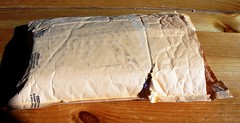
This post is not primarily about the glasses, though.  It's about the packaging.  I ordered directly from the company, and they shipped them in a padded envelope.

Gunnar Optiks Packaging 1


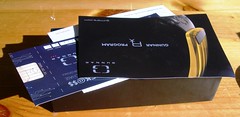
Inside the envelope they added a coupon for my next pair and assorted product literature.

Gunnar Optiks Packaging 2

The glasses were inside a cardboard box.

Gunnar Optiks Packaging 3

I lifted the lid and found foam protecting an inner box.

Gunnar Optiks Packaging 4

That covered a metal box.

Gunnar Optiks Packaging 5

Inside the metal box, there is a lens cleaning cloth/bag.

Gunnar Optiks Packaging 6

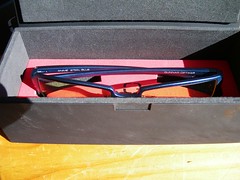
Beneath that, I finally found the glasses, secured in cardboard.

Gunnar Optiks Packaging 7

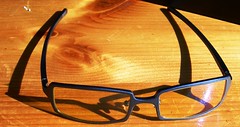
Here they are unfolded.

Gunnar Optiks Packaging 9

This is awesome packaging, and if I used them solely at my desk, I might be willing to use the packaging.  It's a little too bulky and pointy (metal corners) to travel with, though.  And I'm not sure what TSA would think of that rectangular metal box.  So I took the cleaning cloth/bag, and re-purposed an old Eddie Bauer sunglasses case. It provides adequate travel protection.

Gunnar Optiks Packaging 10

The other problem I have with the packaging is that the literature is too big.    The cards and flyers should be small enough to fit in the cardboard box, but they aren't.  I had to fold and crease them up so they would fit.

Gunnar Optiks Packaging 11

Gunnar Optiks Packaging 12

This may seem like a stupid thing to complain about, but Gunnar has guaranteed the literature will go  in the trash.  If it was a more basic packaging job, the literature wouldn't bother me. But they spent a lot of money on this.  It seems silly to not coordinate the literature size with the box size.

Regardless, I'm pleased with my glasses.  If you spend alot of time looking at computer screens, and color correction is not critical, you may want to check them out.

2010-04-23

Stop Alzheimer’s and Dementia patients from wandering off

Alzheimer’s and Dementia patients can have a break with the present.  They can be convinced they are decades younger than they are and have to do something or go someplace they used to do or go 25 years ago.  The can slip out of their assisted living facilities and head out into the world, unprepared for the weather or dangers they face, especially since they can be in their own separate reality at that point.  How do stop this?

One solution would be to put better locks on the assisted living facility, and increase security.  But then you start turning it into a prison.  A facility in Germany came up with a better idea.

They built a bus stop to nowhere right outside.

To go about their important business, the patients first are convinced they need to catch the bus.  When someone now wanders off, staff don't have to chase them through the town. 

Because the patient will usually be waiting for the bus.  At that bus stop.  And the bus will never come.

I heard this story on WNYC's Radiolab podcast.  It's 15 minutes along and it is a fascinating, sad, hopeful, and well told story that is more than work the quarter hour.  You can read more and listen to it here.

2010-03-28

No longer misleading the DMV

I just hit a goal that I didn't even know I had until about a week ago.
I just got my new driver's license in the mail, which was actually part of a wonderfully simple process.  The state sent me a note saying it was time to renew and that I could do it online.  I took the note on a trip to Phoenix, and from my hotel, found the site, checked that my info was correct, gave them my credit card number, and a week later, they sent me my new Driver's License.  It was so much better than trekking down the the Jamaica DMV in Queens in the late 80s.

But when I checked my license, I saw my weight was listed at 240.  "Huh," I thought.  "That's not too far off."

And as of tonight, I reach a new goal.  I now weigh what it says on my license.  My actual weight and my state reported weight haven't matched in, well, ever.


I know some people are horrified at the idea of posting their weight publicly.  It doesn't bother me too much because it's not like people I know in real life are under the illusion I'm skinny.  It's no "secret shame." It's pretty obvious that I'm a big guy.

I'm down about 15 pounds since 2009-10-31.  At my biggest I was up around 265 3-4 years ago.


For an number of reasons I decided to make some small changes this past fall.  For example, while I always fit entirely in my own coach seat, even on a regional jet, it wasn't always pleasant.  And if the person next to me spilled past their own seat, well, there was no room for error.

I've been losing at about 3 pounds a month, which isn't quick, but it is likely sustainable.  I'm doing it without major lifestyle changes, too.

When I'm at home, I spend about 60-90 minutes on the Wii Fit Plus. (See 5 Things I like about the Wii Fit Plus and 5 Thing I don't like about the Wii Fit Plus.)  That's actually how I started -- just using the Wii Fit Plus.  And it helped.  I attribute that fact that I'm accomplishing any of this completely to the Fit.

I started taking the stairs in my building whenever I'm not carrying too much stuff. I live on the 5th floor and can make it all the way up without being too winded. 

I've reduced my regular soda drinking.  Now I mainly drink diet soda, water, juice, wine, beer, or other items.  I still have the regular stuff from time to time, and am not jumping on the corn-syrup-is-evil bandwagon.  As with most things, moderation is key.

I really enjoy eating good food, and I'm not willing to give up the wonders of bacon and butter and meat.  It's just not going to happen.  What I can do is make sure that if I'm going to eat stuff that's bad for me, that I eat it because I am actually hungry or because I really want it.  Eating just because it's time to eat, or because something happens to be in front of me, is a bad idea.  The key here is to eat deliberately and intentionally.

A few years ago I switched to 2% Lattes.  I tried the Soy ones, but they were nasty (which is funny because I do enjoy things like Miso, Edemame, and even Tofu).  More recently, I switched primarily to Americanos and often drink my coffee black.  I'll explain the reasons for that switch in the coming weeks.

I try to walk more.  I live in a fantastic neighborhood and plan to explore it more this summer.

So it's been a lot of little things.  I'm not swearing off any food that's "bad" for me.  This biggest change is the hour+ on the Wii Fit and that's mainly come at the expense of some time wasting on the net.

Where do I go from here?

Well, in a couple months, the summer will be here and once again, I'll be hauling 7, 50 pound water jugs up the stairs and out to the roof most days, so I may pick up the pace there. 

I was hoping to make 235 by the end of the month, but that might be pushing it. Here are my target weights for the next 12 months.
  • 2010-05-15: 230
  • 2010-06-30: 225
  • 2010-09-30: 215
  • 2010-11-25: 210 (Thanksgiving)
  • 2010-12-31: 220 (Holiday food it too awesome to worry about it)
  • 2011-03-30: 199
Does anyone else have a weight at or below what it says on their license?

2007-12-28

Sleep 06: Orexin A

During the summer I commented on the drug Modafinil (Provigil) and its use in replacing sleep.

Development in other sleep replacement drugs is also going on. Researchers studying narcolepsy discovered that many patients lack Orexin.

The research follows the discovery by Siegel that the absence of orexin A appears to cause narcolepsy. That finding pointed to a major role for the peptide's absence in causing sleepiness. It stood to reason that if the deficit of orexin A makes people sleepy, adding it back into the brain would reduce the effects, said Siegel.

"What we've been doing so far is increasing arousal without dealing with the underlying problem," he said. "If the underlying deficit is a loss of orexin, and it clearly is, then the best treatment would be orexin."


Initial research on monkeys is promising:

The monkeys were deprived of sleep for 30 to 36 hours and then given either orexin A or a saline placebo before taking standard cognitive tests. The monkeys given orexin A in a nasal spray scored about the same as alert monkeys, while the saline-control group was severely impaired.

The study, published in the Dec. 26 edition of The Journal of Neuroscience, found orexin A not only restored monkeys' cognitive abilities but made their brains look "awake" in PET scans.

... More

Assuming the product has few side affects and is not addictive, the potential gains in personal productivity are staggering.

The full article appears on Wired.

2007-11-25

How old are you?

According to the Real Age website (I found the link on digg.com) my real age is 29.2 (versus my actual age of 36) and my life expectancy is 80.8. The test considers a variety of factors like biology, heredity, and life style choices.

I think the 80.8 is a bit pessimistic for my tastes. Given advances in technology over the coming decades, I'm targeting 150 as a minimum. As for the 29.2 estimate for my real age -- I'm still holding on kicking and screaming to 27.

So, how old are you? Take the test here.

2007-10-03

Cheating Sleep

I planned to watch Heroes on Tivo at 2:00 AM tonight, but apparently, Tivo thinks it's crazy for people to watch TV that late, and told me it wouldn't let me watch because it was updating it self.

On Wired's How To section, they offer an introduction to polyphasic sleep, and they offer suggestions on how to get better quality sleep, even if you get few hours.

The schedules the suggest are a bit rigid for my taste. I'll stick with my 4-6 hours a night during the week and 10-12 hours a night on the weekend.


A six-year study Kripke headed up of more than a million adults ages 30 to 102 showed that people who get only 6 to 7 hours a night have a lower death rate than those who get 8 hours of sleep.

...More

2007-09-26

Resistance is Futile 02: Out of Memory Error

In the current issue of Wired (15.10), columnist Clive Thompson talks about the recent decline human memory. He suggests that reason people remember less now is because they don't need to.

That reflexive gesture — reaching into your pocket for the answer — tells the story in a nutshell. Mobile phones can store 500 numbers in their memory, so why would you bother trying to cram the same info into your own memory? Younger Americans today are the first generation to grow up with go-everywhere gadgets and services that exist specifically to remember things so that we don't have to: BlackBerrys, phones, thumb drives, Gmail.


But is this a problem?

In The Matrix, when people needed to learn a new skill, they could just have it downloaded into their mind. I'd like to be able to do that. Imagine the possibiliities of having a memory card slot in your head that allowed you to download new information or skills.

I've talked before about adding senses, VR goggles, Modafinil, and other ways the improve on biology. Biology and technology continue to converge.

But in reality, are we alread there? Sure we can't download the information immediately into the brain, but we can get it all on the internet.

It may seem obvious, but the problem is nothing more than an interface one. The Keyboard-Mouse-Ears-Eyes interface between the Internet and the brain is simply too slow and clumsy.

And that's the realm where improvements will come in the next few decades. Either the interface will be improved, or it will be replaced.

To expand the idea even further, at what point does the body itself superflous?

2007-09-25

Book Review 13: Flow and Gel


Whatever you name these people related problems, they’re more likely to cause you trouble on your next assignment than all the design, implementation, and methodology issues you’ll have to deal with. In fact, that idea is the underlying thesis of this whole book: The major problems of our work are not so much technological as sociological in nature.

Page 4


In December of 2003, while on vacation, I dove into Excel. I sat in an aging recliner, with a notebook in my lap, and wrote macros, built formulae, and taught my self to write in visual basic. The 6 or 7 hours flew by, and by the end of the evening I had turned a detailed weekly reporting system into a beautiful automation tool that would save me an hour or more per week.

Whether it was wise or not to work on vacation I’ll leave to another discussion. But I distinctly recall what a joyful process it was to dive in to Excel and make something.

I had achieved flow.


During single-minded work time, people are ideally in a state that psychologists call flow. Flow is a condition deep, nearly meditative involvement. In this state, there is a gentle sense of euphoria, and one is largely unaware of the passage of time: “I began to work. I looked up, and three hours had passed.” There is no consciousness of effort; the work just seems to, well, flow. You’ve been is this state often, so we don’t have to describe it to you.

Page 63


That wasn’t the first or only time I have hit that flow state. In my job, I often have to drop in to that realm. Fortunately, I have the luxury not going into a corporate cubicle environment.

In Peopleware: Productive Projects and Teams (2nd Edition) Tom DeMarco and Timothy Lister take modern corporate management to task for the way it destroys productivity in software development. The book is well structured, easy to read, and entertaining. The authors talk about some theory, but much of the discussion is drawn from their own experiences as consultants. The book is filled with actual stories and with tips managers can start using right away to help their developers succeed.

In a modern US economy that celebrates the triumph of the knowledge worker DeMarco and Lister focus on how business treat them like assembly line factory workers. While corporations push their products toward the 21st century, they often mange worker like it’s still the 19th century.

The authors cover a lot of ground in supporting the thesis I mentioned in the introduction, but most of the material focuses on two areas – flow and gel.
They contrast development work with the factory production challenges.


Steady-state production thinking is particularly ill-suited to project work. We tend to forget that a project’s entire purpose is to put itself out of business. The only steady-state in the life of a project is rigor mortis.

Page 10


Everything at a fast food restaurant can be reduced to steps and those steps can be made to maximize efficiency. The equipment can be modified and relocated to maximize efficiency. Workers don’t need special skills because all they need to do is continually execute a set of predefined steps. Management’s role to keep workers focused on task and steps, and workers are as easily replaceable as a damaged fryer.
But that doesn’t work for developers.


These would be reasonable approaches if you were in the fast food business (or any production environment), but you’re not. The “make a cheeseburger, sell a cheeseburger” mentality can be fatal in your development area. It can only serve to damp your people’s spirits and focus their attention away from the real problems at hand. This style of management will be directly at odds with the work.

Page 7


And they have a point. There is a difference between creative work and repeatable work. There is an undertone of elitism in that passage, though, and it continues through the book. They seem to feel software developers are a special breed. They are better, more important, more reliable, and more valuable that other employees.
While I have never been accused of radical egalitarianism, there is something distasteful in the attitude the authors seem to adopt.

But it is forgivable. Their background is in the software development and project management business. They are advocating on behalf of the developers. They believe developers really want to work and produce great products, almost as if it is a calling.

And given the salaries many developers make, corporations should probably treat them that way.

DeMarco and Lister compare the investment in salaries to the investment airlines make in airplanes. An airline only makes money if the planes are in the air. They are loathe to spend millions of dollars on hardware, only to leave it sitting on the tarmac.


The human capital invested in your work force also represents a ton of money. If your company employs a few thousand knowledge-workers, it could easily have enough invested in them to be the equivalent of a modern wide-body aircraft. Wasting the time of that huge investment is money poured down the drain.

Page 221


DeMarco and Lister make a compelling argument that interruptions are the biggest destroyer of productivity in the development world. The state of flow is essential to producing quality work quickly, but flow can’t be achieved on a moments notice. It takes time to drop into that state, and each time a worker is interrupted, they come out of the flow state and lose time dealing with both the interruption and the time required to get back into flow. Hopefully they get there before they face another interruption.


Fragmentation is particularly injurious when two of the tasks involve qualitatively different kinds of work habits. Thus, the mix of a design task (which requires lots of immersion time, relative quiet, and quality interaction time with a small group) with a telephone support task (which requires instant interruptibility, constant availability, quick change of focus) is sure to make progress on the more think-intensive of these tasks virtually impossible. The time wasted continually trying to get restarted is perceived only as frustration by the worker. You may never hears about it, because the people who suffer form this problem are all too likely to blame themselves.

Page 220


The authors heap much of their derision on the ever present telephone.


When electronic mail was first proposed, most of us thought that the great value of it would be the saving in paper. That turns out to be trivial, however, compared to the saving in reimmersion time. The big difference between a phone call and an electronic mail message is that the phone call interrupts and the email does not; the receiver deals with it at his or her own convenience. The amount of traffic going through these systems proves that priority “at the receiver’s convenience” is acceptable for the great majority of business communications.

Page 73

More important than any gimmick you introduce is a change in attitude. People must learn that it’s okay sometimes not to answer their phones, and they must learn that their time – not just the quantity but its quality – is important.

Page 74

It is natural that the telephone should have reshaped somewhat the way we do business, but it ought not to have blinded us to the effects of the interruptions. At the least, managers ought to be alert the effect that interruption can have on their own people who are trying to something done. But often, it’s the manager who is the worst offender. One of the programmers in the 1985 Coding War Games wrote on his environmental survey, “When my boss is out, he has his calls switched to me.” What could the manager have been thinking? What was going on in the mind of the systems department head who wrote this in a memo:

“It has come to my attention that many of you, when you are busy, are letting your phone ring for three rings and thus get switched over to one of the secretaries. With all these interruptions, the secretaries can never get any productive work done. The official policy here is that when you’re at your desk you will answer your phone before the third ring….”

Page 72


The phone is not the only problem, though. They spend a great deal of time talking about modern office furniture. The book is a great indictment of the modern cubicle work space:


Today’s modular cubicle is a masterpiece of compromise: it gives you no meaningful privacy and yet still manages to make you feel isolated. You are poorly protected from noise and disruption; indeed in some cases, sources of noise and disruption are actively piped into your space. You’re isolated because that small lonely space excludes everyone but you (it’s kind of a toilet stall without a toilet). The space makes it difficult to work alone and almost impossible to participate in the social unit that might form around your work.

Page 86


While DeMarco and Lister offer solutions to the ever present flow challenges, they also tackle the other key element of a development project – team cohesion. Their focus is on how to help teams gel.

It may seem contradictory at first. The first part of the book is all about empowering the individual worker to excel by hitting the flow state. Then the second half of the book talks about what it takes to make the developers work together.

The authors do a nice job of blending these concepts. Changes to the office that accommodate flow can also accommodate team work. The key is that workers on a team that gels, or achieves a high level of cohesion end up working together well, and then working by themselves well – on essentially the same schedule.

One of the most valuable sections of the book was the one where they introduce their recommendations for how to prevent teams from gelling. And it really had nothing to do with the main point.


Back to brainstorming mode: we began looking for “Six Things You Can Do to Make Team Formation Possible.” It was still hard. At last, in desperation, we tried a trick called inversion, described in Edward deBono’s Lateral Thinking. When you’re stuck trying to solve a problem, deBono suggest that rather than looking for ways to achieve your goal, look for way to achieve the exact opposite of your goal. This can have the effect of clearing away the brain’s cobwebs that keep you from being creative. So instead of looking for ways to make team formation possible, we began to think of ways to make team formation impossible. That was easy.

Page 133


Inversion is a simple idea with the potential to deliver powerful results. I plan to use the next time I am stuck for ideas.

I don’t agree with everything DeMarco and Lister discuss. They have howl at things like motivational posters.


These motivational accessories, as they are called (including slogan mugs, plaques, pins, key chains, and awards), are a triumph of form over substance. They seem to extol the importance of Quality, Leadership, Creativity, Teamwork, Loyalty, and a host of other organizational virtues. But they do so in such simplistic terms as to send an entirely different message: Management here believes that these virtues can be improved with posters rather than by hard word and managerial talent. Everyone quickly understands that the presence of the posters is a sure sign of the absence of hard work and talent.

Page 178


When I see those things, I don’t get that same impression. While I can see the point DeMarco and Lister are making, I find those tools can be useful for reminding me about the broader context. They are so much about teaching the concepts of Creativity, Teamwork, Loyalty, or Perseverance. The are more of a reminder that it’s not just about the email I’m sending, of the document I’m writing, or the presentation I’m preparing. It’s all about something bigger -- the quest to the job well for the sake of doing the job well. Those motivations accessories become a touch point for deeper thought. They are a reminder to not forget why I work hard.

And it’s possible I see the differently simply because I work in marketing, rather than the software development field DeMarco and Lister are writing about.

In general, the authors feel that effective management is really about getting out of the way:

Sharon knew what all good instinctive managers know: the manager’s function is not to make people work, but to make it possible for people to work.

Page 34


Peopleware: Productive Projects and Teams will be most valuable to those managing engineering and development teams. Others will also benefit from the discussions of the work process. It’s a fascinating look at what works and what doesn’t work with knowledge workers today.

If you’re interested in a book of specific how to tips to help people do their work better – and one that is backed up with some theory—this is a great choice. It’s fun, easy to ready, and practical

2007-07-24

Sleep 02: Sleep is Obsolete

Well, almost.


Sleep-deprived groups ranging from truck drivers to the military have experimented with modafinil, marketed for nearly a decade by Cephalon under what Plotz calls the "creepy, pharma-Orwellian" name Provigil.

Military officials have found it so effective that some now refer to it as a "super drug." But its off-label uses have created a rich debate on how far to push the limits of the human body.

For Plotz, the results were immediate.

"I am the picture of vivacity," he wrote on Slate.com.

Even with only five hours sleep, he could write twice as fast and felt alert.

"I have a desperate urge to write, to make reporting calls and to finish my expense account – activities I religiously avoid," he wrote. "I find myself talking loudly and quickly. A colleague says I am grinning like a 'feral chipmunk.'"

...
Until now, the military has used amphetamines or "go pills" for its pilots, but the side effects of amphetamines can cause problems. Investigators blamed those drugs for a 2002 incident in which American pilots inadvertently killed four Canadian soldiers in Afghanistan.

In studies funded by the Air Force Office of Scientific Research and Cephalon, modafinil has proved to be a better drug.

Scientists treated 16 healthy subjects, depriving them of sleep for 28 hours and then expecting them to sleep from 11 a.m. to 7 p.m. for four days and stay awake through the night. Those on modafinil did far better on cognitive tests than those on a sugar pill. Some could stay awake for more than 90 hours, according to Moreno.

... More


I've followed the developments on Mondafinil and Provogil for several years now. I think I first read about it when I was living in Boise in 1997.

It's an interesting concept for a drug. You don't get high. You don't get addicted. There don't appear to be long term consequences.

But you don't have to sleep. You can stay awake, alert and sharp for ridiculously long periods of time.

When I sleep on weekends or vacations, I can sleep for 10-14 hours straight with now problem. During the week, I can function well, on 5 hours a night. I can get by with the occasional alnighter and do okay on a couple of 3-4 hour nights.

And when I sleep for long periods of time, I do enjoy it.

But.

The idea of having extra hours of high productivity appeals to me. It seems there's never enough time in the day for everything I need/want to do. To get everything done and have time for myself, something has to go. And usually that something is sleep.

A product like Provigil has the potential to change things. When I forgo sleep today, I do suffer a performance penalty. I'd really like to avoid that penalty.

Is it right to take medication to alter the normal function of the body for my convenience? Is it ethical?

I used to think it wasn't. I used to think to most important thing was to rely on sheer Biology. But I've been coming around on that. Why not take advantage of the wonders of modern chemistry?

People legitimately hack their bodies all the time with. And they do it not to heal an injury but to alter they way the body functions to make their lives easier or simpler.

We see new advances in vitamins and nutrition that are anything but natural. Caffeine intake is another way many people try to push pass the limits of the body. Are the complex exercise regimens people take on natural?

And is using something like Provigil to alter human sleep patterns all that different from using birth control pill to alter the human endocrine/reproductive system?

But I haven't done anything yet. Like LASER eye surgery, I still look at Provigil with some concern about the long term effects and the possibility of addiction.

But the more I learn, the more I like what I see.

2007-05-30

Making Sense of the World

I just learned there are actually 6 senses, rather than 5.


There's a reasonably well-accepted sixth sense (or fifth and a half, at least) called proprioception. A network of nerves, in conjunction with the inner ear, tells the brain where the body and all its parts are and how they're oriented. This is how you know when you're upside down, or how you can tell the car you're riding in is turning, even with your eyes closed.


It's part of a recent Wired article (available on line) that explores different ways of enhancing the senses that people have. The implications for those who want to treat disabilities or those who simply want to enhance the human mind and body are fascinating.


For six weird weeks in the fall of 2004, Udo Wächter had an unerring sense of direction. Every morning after he got out of the shower, Wächter, a sysadmin at the University of Osnabrück in Germany, put on a wide beige belt lined with 13 vibrating pads — the same weight-and-gear modules that make a cell phone judder. On the outside of the belt were a power supply and a sensor that detected Earth's magnetic field. Whichever buzzer was pointing north would go off. Constantly.

...

Direction isn't something humans can detect innately. Some birds can, of course, and for them it's no less important than taste or smell are for us. In fact, lots of animals have cool, "extra" senses. Sunfish see polarized light. Loggerhead turtles feel Earth's magnetic field. Bonnethead sharks detect subtle changes (less than a nanovolt) in small electrical fields. And other critters have heightened versions of familiar senses — bats hear frequencies outside our auditory range, and some insects see ultraviolet light.

We humans get just the five. But why? Can our senses be modified? Expanded? Given the right prosthetics, could we feel electromagnetic fields or hear ultrasound? The answers to these questions, according to researchers at a handful of labs around the world, appear to be yes.

It turns out that the tricky bit isn't the sensing. The world is full of gadgets that detect things humans cannot. The hard part is processing the input. Neuroscientists don't know enough about how the brain interprets data. The science of plugging things directly into the brain — artificial retinas or cochlear implants — remains primitive.

... More

2007-03-16

Resistance is Futile 01: Treating Parkinson's


I wake up as they wheel me into recovery, which at Stanford is a kind of fun house sideshow. People in various states of undress — many of us having just had parts removed or new parts installed — loll or roll about in pain and confusion, all under the watchful eyes of a room full of nurses, orderlies, and aides. The occasional doctor breezes through to provide expert advice or — because this is a teaching hospital — comic relief. The nurses, rolling their eyes, patiently guide the young doctors like sergeants working with newly minted lieutenants.


That's my favorite paragraph from a great article about Parkinson's Disease that appear in the March 2007 (15.03) issue of Wired.

Author Steven Gulie talks about how he developed Parkinson's and how doctors treated the symptoms successfully by implanting electrodes directly in his brain and then installing essentially a brain pacemaker in his chest.

It's a long article but a great read.