
2006-03-01
Where in the World is Mort Normstein?
This weekend, we added two more Mort Normstein videos to the PlayCole.com website. Mort continues to take his journeys around the country. Visit www.playcole.com to see his latest destination.


starbucks andrew torres - Yahoo! Search Results
starbucks andrew torres - Yahoo! Search Results
I welcome all visitors to my Blog, and the web tracking information is sometime enlightening, and some time just weird.
One of yesterday's visitors arrived by doing a Yahoo! search on "starbucks andrew torres".
I hope this person found what they were looking for.
Part of me wants to know the story behind the search, but the rest of me is happy with the mystery.
I welcome all visitors to my Blog, and the web tracking information is sometime enlightening, and some time just weird.
One of yesterday's visitors arrived by doing a Yahoo! search on "starbucks andrew torres".
I hope this person found what they were looking for.
Part of me wants to know the story behind the search, but the rest of me is happy with the mystery.
An Independent Closes

On Dining: Coffee Messiah grinds to a halt and Fish Club catches a new chef
A local coffee shop in Seattle closed down. The business just wasn't there for the new owners of Coffee Messiah. When I would walk past, there were usually decent crowds, but that isn't always the most reliable indicator of success.
It wasn't one of my regular haunts. I've gotten coffee to go there, but personally never felt comfortable hanging out in the cafe.
The shop was decorated in a lot of black with crosses and crucifixes everywhere. It's been a while since I've been there, but the decor didn't strike me so much as alternative as it did blasphemous. It seemed to be not so much a secular place as an anti-religion place. It was too "in your face" for me. The agresivness of it seemed wrong. A lot of people felt comfortable there; I was not one of them.
It had a strong counter-culture, anti-corporate, revolutionary, and alternative feel. It did not seem to be the best place for me to sit down wearing my business casual clothes, pull out my notebook, and get some work done for a large multi-national corporation.
It's a tight market. There are lots of great coffee places near by. Two of my favorites are the Bauhaus and the Starbucks up the hill.
The Bauhaus has an eclectic clientele that reflects the diversity of the Capitol Hill. They have free WiFi, a loft with ancient tables, and a wall lined with books. A wall covered with books is instantly relaxing. There are a lot of college students working independently or with one other person. The coffee is great, the staff is nice, the music is interesting, the bandwidth is good, the view of the Space Needle is nice, and the people watching is fantastic.
The Starbucks up the hill is one of the largest in the area. It has different kind of crowd. There are more high school students working on projects, or college students working in groups. There are business meetings and interviews taking place, but they are usually for community support organizations of some sort. The clientele is older. The staff is friendly, and the coffee is as good as Starbucks gets.
There are plenty of other great shops within a mile, including Cafe Ladro, Uptown Espresso, Cafe Vivace, and Dilletante.
I imagine people will blame Starbucks for the fall of Coffee Messiah. People may accuse Starbucks of running the little guy out of business. The thing is, though, that most of the time, Starbucks is not the cheapest in an area. They compete by offering coffee that people prefer, and an environment more people like. The smaller shops that have sprung up over the past decade or two owe their existence to Starbucks, for creating demand for high-quality coffees. If Starbucks isn't competing on price, they must be competing on something else. That something else is why they are successful.
2006-02-28
Apprentice Week 01: The Most Important Lesson in Business
Shut up.
That's it. Just Shut Up.
I'm a big fan of Trump's Apprentice. It's one of those great yell at the TV screen shows. There are also some key business lessons that can be learned. I know, it's not really a job interview; it's entertainment. But there is plenty of value in there.
The most important and compelling lesson from this show so far, is the importance of knowing when to say nothing.
Many of the people who get fired in boardroom are fired not only because of what they did, but what they said attempting to defend themselves.
****Potential Spoiler Alert If you haven't watched Monday's episode, yet.*****
*
*
*
*
*
*
*
*
Okay. Summer was on the borderline of being fired. Then Trump starts going after the project manager and seems about to fire him. What does Summer do?
She interrupts Trump to defend the guy who is about to be fired.
This is the guy who tried to organize everyone else to go after her.
This is the guy who's management style she disagreed with.
This is the guy whom she predicted had led their team to failure before knowing the results.
This is the guy who is about to be fired instead of her.
And she interrupts Trump. Trump then turns to her to suggest she should be quiet. She keeps talking and interrupting. She finally talked her way into being fired.
Last season, Rebecca seemed to have mastered that lesson. She spoke up only when absolutely necessary in the boardroom. When Trump went after someone, she generally let him go, unless Trump asked her opinion. When two people went after one another, she stayed out of it. As a result she made it all the way to the final two.
Of course the classic example of talking your way out of the show is Bradford who in Season two was given an exemption, and in the heat of the boardroom exchanges, waived it. That stupidity got him fired.
Of course, staying quiet is harder than it might seem. It's a lesson I keep trying to remember. Generally, I learn a lot more when I remain quiet and listen to others. I find I'm most likely to get in trouble in various aspects of life by speaking too much, rather than too little. It's all about tying to keep my ego on a tight leash, and why most of the entries in this blog end up several paragraphs shorter when I publish them than when I write them.
This ties back to one of my earlier posts about writing. A key element of good writing is editing or cutting material. A key element for success in business is know when to stay quiet and not say anything.
2006-02-27
Now it looks impressive

I'm a bit of a junkie for the History Channel, although I think they've been reaching a bit with some of the Modern Marvels, lately. (Are Loading Docks; Cattle Ranches; and Axes, Swords, and Knives really all that modern and marvelous?)
Tonight, however, I'm watching Titanic's Final Moments: Missing Pieces. I'm captivated.
It's another documentary, this time focusing on an August 2005 dive made to Titanic, using new submersibles. They are investigating a theory that not only did Titanic suffer starboard hull damage from the iceberg, but what really doomed the ship was grounding damage. Perhaps Titanic ran over the iceberg, in addition to running into it. That damaged the bottom of the ship's double hull and contributed to the sinking.
It could also potentially explain why the stern split from the bow, took heavier damage than the bow, and ended up 800 meters away form the bow at the bottom of the north Atlantic facing the wrong way. And why there's a trail of coal more than a mile long leading from the wreck.
When Robert Ballard's expedition initially found the ship in 1985, I was impressed, but pictures was grainy, and it took a lot of effort to really see what was in them. I had always been interested in the sinking since it coincided with my birthday, as did an number of other unfortunate world events (like the death of Lincoln). And I wanted to see more.
Twenty years have lead to significant improvements in underwater photography and lighting. The images the History Channel is broadcasting are colorful, detailed, and eerie in way the previous images weren't.
Then engineering story and the photography are incredible enough. Combining that with the idea that this is the grave yard for well in excess 1,000 people makes for a terribly compelling
story.
2006-02-25
The new funny man
If you've followed the news about Play Cole, you may already know that Jon and Andrew have been successfully doing stand up for two months now.
A video of one of Andrew's appearances is on his website at www.andrewtorresny.com . It's some funny stuff. Check it out when you can.
A video of one of Andrew's appearances is on his website at www.andrewtorresny.com . It's some funny stuff. Check it out when you can.
2006-02-24
Calling New York area cat lovers...
MacSurfer picked up yesterday's post where I predicted Apple will license the Mac OS to other hardware vendors as a way out of the hardware business, and focus more on the content and software business. More than 400 hundred people visited over the next 10 hours. This will be a slight change of pace.
I have two cats I am trying to find homes for.


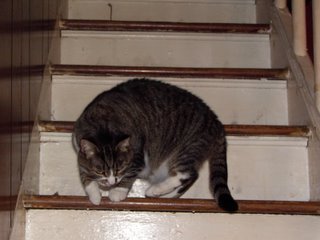
Chase is the white cat. He is the friendliest cat I've ever met. He immediately gets know strangers and seeks out affection. Sit down in the same room and he will come right up next to you.
Layla is the other cat. She is also friendly, but in a more traditional cat-like manor. She gets along well with people without always being underfoot.
The cats have been been holding down the fort in an unoccupied house for nearly a year. Prior to that, they shared the house with a dog, a bird, some other pets and a human. It's a long story.
Amazingly, despite being on their own most fo the time, they have maintained strict litter box discipline.
The house, however, is being sold, and we need to find a new home for these two wonderful cats. I considered taking one myself, but my apartment, combined with my heavy travel schedule is not a pet friendly environment. Plus, it didn't seem fair to subject the cat to the cross country airplane flight.
I would like to find a home for one or both of these pets before we have to take them to shelter. If you, or someone you know would like to provide a good home for these cats, please contact me.
Here is some more information my mother provided:
I don't want this to sound like an NPR fund raiser, but if you can help, please let me know.
I have two cats I am trying to find homes for.

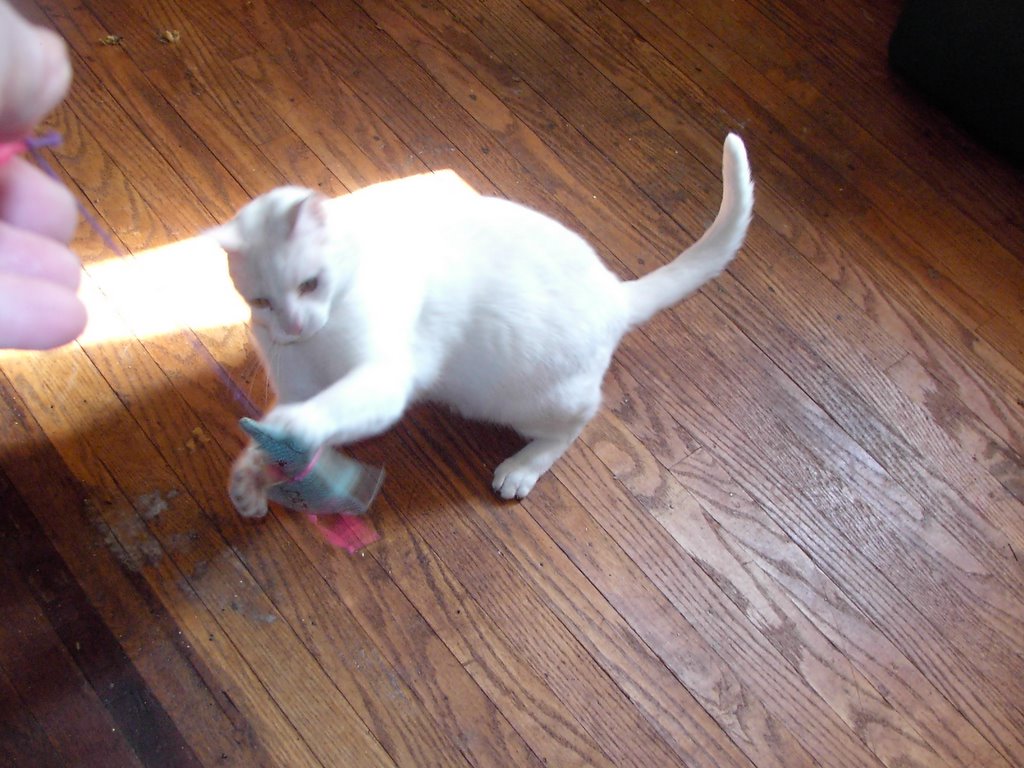


Chase is the white cat. He is the friendliest cat I've ever met. He immediately gets know strangers and seeks out affection. Sit down in the same room and he will come right up next to you.
Layla is the other cat. She is also friendly, but in a more traditional cat-like manor. She gets along well with people without always being underfoot.
The cats have been been holding down the fort in an unoccupied house for nearly a year. Prior to that, they shared the house with a dog, a bird, some other pets and a human. It's a long story.
Amazingly, despite being on their own most fo the time, they have maintained strict litter box discipline.
The house, however, is being sold, and we need to find a new home for these two wonderful cats. I considered taking one myself, but my apartment, combined with my heavy travel schedule is not a pet friendly environment. Plus, it didn't seem fair to subject the cat to the cross country airplane flight.
I would like to find a home for one or both of these pets before we have to take them to shelter. If you, or someone you know would like to provide a good home for these cats, please contact me.
Here is some more information my mother provided:
The white cat, Chase, has green eyes and a pink nose. He is very affectionate and not afraid of strangers. Layla, the other cat is not as affectionate, but still very friendly, and also is not afraid of strangers. They are not skittish. They were raised in a house with dogs and have been together for almost two years. They have both been neutered and had shots, but I have no records on that. They are between two and three years of age. I cannot say whether or not they are good with children, as I don't think they were ever exposed to them. They get along with each other very well, mutually washing each other and sleeping together.
I don't want this to sound like an NPR fund raiser, but if you can help, please let me know.
Apple to License OS X to other Hardware Vendors (a prediction)
I general, I find myself agreeing with John Dvorak, the maverick pundit at PC Magazine. This time, however, he's wrong.
In a recent column, he outlined the theory that Apple was going to migrate from OS X to Microsoft Windows.
He has it backwards, however. My prediction is that Apple will eventually get out of the Mac hardware business, or at the very least, revisit the practice of licensing the Mac OS to other hardware vendors.
Before I go any further, let me say I am not interested in taking sides in the Windows versus Mac holy wars that seem to inevitably erupt in any of these discussions. There is value in both platforms, and problems with both. Today, I am more interested in the various business models, rather than any question of technical superiority.
To begin with, Apple products have a great reputation for simply working together. Whether that reputation is deserved or not is beside the point. Apple tightly controls their compatibility requirements, tightly controls their software requirements, and by making their own desktops, knows exactly which pieces of hardware need to work.
Microsoft has done an incredible job of making Windows work on hundreds of thousands of different hardware configurations from vendors around the world that they cannot control. People may snicker, but I can walk into nearly any computer store and know that 90% or more of the products are likely to work with my Windows machine, whereas if I walk into an auto parts store, a significantly smaller percentage of components will work in my Subaru. The broad compatibility in the computer industry is amazing.
Last year, Apple announced it was going to launch computers based on the popular Intel architecture, and at Macworld 2006 in January, they actually announced their first machines based on the new Intel Core Duo platform, the latest iteration of Centrino Mobile Technology.
To back up for a moment, we now have Apple running its OS on the same Intel platform that Windows runs on. Apple developed a utility called Rosetta to allow older PowerPC (previous Apple CPU Architecture) applications to run on the new x86 Intel architecture.
When Apple introduced OS X several years ago, they made a key change. They based the core parts of the OS on Unix. At that point they had the key elements in the OS to support running it on multiple platforms.
So now, the OS can run on the Intel Platform. Most of the applications can run on the Intel platform. New hardware is based on the Intel platform.
Here's where Dvorak and I begin to disagree. He takes the stand that Apples is a hardware company with a great user interface. He suggests they will abandon their core software and just maintain the interface running on top of Windows.
First of all, I don't see Microsoft licensing Windows to Apple if Apple is going to hide the Windows interface with its own. Apple would probably have to go to the Department of Justice and claim antitrust issues, and it would take years to work its way through the courts.
Second, I don't see Steve Jobs "caving" into Microsoft after all these years and essentially saying that Apple isn't as good as Windows. Even though Apple no longer runs the "switch" ads on TV, they still maintain that messaging on their website. Whether abandoning the Unix core of the Mac OS it right or wrong from a technological point of view, I don't see it happening because of the egos involved.
There is another key point that is problematic for a switch from Mac OS to Windows on Apple computers. Dvorak says:
First I think it's a tad myopic to look at the iPod business as primarily a way to get Windows users to switch to Apple hardware. iPod hardware is successful in its own right, but the real money isn't in the hardware. It's in iTunes. And it's in the video content that Apple is now selling.
Content is nothing but ones and zeroes. After setting up the infrastructure, there are very few costs associated with selling this content. Sure, there are the royalties that get paid, but those costs are only incurred when there is a sale. The true profit in the iPod business will come from selling digital content today and in the future.
It's the same strategy Microsoft employs with the XBox 360, or Sony employs with the Playstation. It's not about selling the console. It's about selling the software and the content.
Going back even further, is the strategy Gillette employed in the 1800s to sell razors. Sell the razor cheap so you can sell blades down the road. Afterall, that's where the real money it.
Thus, my prediction (finally). Apple will release its OS to other manufacturers. One day we will see and HP, Sony, or Dell computers running OS X.
If the Apple OS works on the PC (Intel) platform, and the Apple applications work on the Intel platform, then why should Apple maintain it's own hardware platform?
Dvorak claims Apple can surpass its 5% market share and compete with Dell, HP, and others and produce high margin Windows machines. That doesn't make sense to me. There are very few high margin Windows machines, and that market isn't getting bigger.
Average selling prices have been dropping for years. Margins have been getting tighter. That isn't going change just because you can get a piece of Apple hardware with Windows in it.
Here's a secret most people may not realize about computer hardware. Computers and computer components in stores, warehouses, and shipping containers are like rotting vegetables sitting in the supermarket. Every day they are worth less.
If a computer maker or retailer doesn't sell it today, they get less money when they sell it tomorrow. If you don't build or order enough units, you lose a lot of opportunities. You can't simply order more of the same thing because product development cycles are too tight. They will arrive too late.
The bigger problem is when you overestimate demand, however. You build too many of a machine and it doesn't sell fast enough. Now you have to drop the price. But you still have to pay for your components. If you build too many, you are in big trouble, and can lose a ton of money.
The most successful PC companies have developed expertise in managing demand and inventory, and that is a very tough business.
So far, Apple has been fairly immune to that. If they underestimate demand on a product, they can adjust their own release calendars until the hardware sells. They really aren't competing with other PC makers.
Why would Apple want to focus primarily on the hardware business?
Becoming solely a software company can be a much more lucrative opportunity. If you release your OS to vendors, all you are physically sending them is a few DVDs. If you underestimate demand, you don't have shortages. You can sell an infinite number of licenses, which, really, are just permission to use the software. If you overestimate demand, you don't have millions of dollars in sunken hardware costs and unsold pallets of machines sitting on shelves.
Apple's expertise in in software and interface design. It's in making it easier for people to use their machines without thinking about how they work. By licensing the OS they can focus on this and free themselves from the hassle of managing physical equipment.
Apple can then limit their hardware sales to selling other vendors' computers through the Apple stores around the country. They already sell other vendors' hard drives, digital cameras, scanners, printers, and iPod accessories. Other manufacturers' computers and notebooks are just a small step.
Further, consider the other users that you know. Are people more likely to buy a Mac Powerbook that runs Windows XP, or are they more likely to buy a Sony notebook that runs Mac OS X?
The future for Apple is clear. Sell more ones and zeroes. Sell less physical stuff. Develop new software and interfaces. Let someone else deal with the challenges of hardware. Then you will see Mac OS market share grow.
In a recent column, he outlined the theory that Apple was going to migrate from OS X to Microsoft Windows.
He has it backwards, however. My prediction is that Apple will eventually get out of the Mac hardware business, or at the very least, revisit the practice of licensing the Mac OS to other hardware vendors.
Before I go any further, let me say I am not interested in taking sides in the Windows versus Mac holy wars that seem to inevitably erupt in any of these discussions. There is value in both platforms, and problems with both. Today, I am more interested in the various business models, rather than any question of technical superiority.
To begin with, Apple products have a great reputation for simply working together. Whether that reputation is deserved or not is beside the point. Apple tightly controls their compatibility requirements, tightly controls their software requirements, and by making their own desktops, knows exactly which pieces of hardware need to work.
Microsoft has done an incredible job of making Windows work on hundreds of thousands of different hardware configurations from vendors around the world that they cannot control. People may snicker, but I can walk into nearly any computer store and know that 90% or more of the products are likely to work with my Windows machine, whereas if I walk into an auto parts store, a significantly smaller percentage of components will work in my Subaru. The broad compatibility in the computer industry is amazing.
Last year, Apple announced it was going to launch computers based on the popular Intel architecture, and at Macworld 2006 in January, they actually announced their first machines based on the new Intel Core Duo platform, the latest iteration of Centrino Mobile Technology.
To back up for a moment, we now have Apple running its OS on the same Intel platform that Windows runs on. Apple developed a utility called Rosetta to allow older PowerPC (previous Apple CPU Architecture) applications to run on the new x86 Intel architecture.
When Apple introduced OS X several years ago, they made a key change. They based the core parts of the OS on Unix. At that point they had the key elements in the OS to support running it on multiple platforms.
So now, the OS can run on the Intel Platform. Most of the applications can run on the Intel platform. New hardware is based on the Intel platform.
Here's where Dvorak and I begin to disagree. He takes the stand that Apples is a hardware company with a great user interface. He suggests they will abandon their core software and just maintain the interface running on top of Windows.
To preserve the Mac's slick cachet, there is no reason an executive softwareThere are a couple problems with this.
layer couldn't be fitted onto Windows to keep the Mac look and feel. Various
tweaks could even improve the OS itself. From the Mac to the iPod, it's the GUI
that makes Apple software distinctive. Apple popularized the modern GUI. Why not
specialize in it and leave the grunt work to Microsoft? It would help the bottom
line and put Apple on the fast track to real growth.
First of all, I don't see Microsoft licensing Windows to Apple if Apple is going to hide the Windows interface with its own. Apple would probably have to go to the Department of Justice and claim antitrust issues, and it would take years to work its way through the courts.
Second, I don't see Steve Jobs "caving" into Microsoft after all these years and essentially saying that Apple isn't as good as Windows. Even though Apple no longer runs the "switch" ads on TV, they still maintain that messaging on their website. Whether abandoning the Unix core of the Mac OS it right or wrong from a technological point of view, I don't see it happening because of the egos involved.
There is another key point that is problematic for a switch from Mac OS to Windows on Apple computers. Dvorak says:
Apple has always said it was a hardware company, not a software company.Historically that may be true, but some interesting things have happened.
Now with the cash cow iPod line, it can afford to drop expensive OS development
and just make jazzy, high-margin Windows computers to finally get beyond
that five-percent market share and compete directly with Dell, HP, and the
stodgy Chinese makers.
First I think it's a tad myopic to look at the iPod business as primarily a way to get Windows users to switch to Apple hardware. iPod hardware is successful in its own right, but the real money isn't in the hardware. It's in iTunes. And it's in the video content that Apple is now selling.
Content is nothing but ones and zeroes. After setting up the infrastructure, there are very few costs associated with selling this content. Sure, there are the royalties that get paid, but those costs are only incurred when there is a sale. The true profit in the iPod business will come from selling digital content today and in the future.
It's the same strategy Microsoft employs with the XBox 360, or Sony employs with the Playstation. It's not about selling the console. It's about selling the software and the content.
Going back even further, is the strategy Gillette employed in the 1800s to sell razors. Sell the razor cheap so you can sell blades down the road. Afterall, that's where the real money it.
Thus, my prediction (finally). Apple will release its OS to other manufacturers. One day we will see and HP, Sony, or Dell computers running OS X.
If the Apple OS works on the PC (Intel) platform, and the Apple applications work on the Intel platform, then why should Apple maintain it's own hardware platform?
Dvorak claims Apple can surpass its 5% market share and compete with Dell, HP, and others and produce high margin Windows machines. That doesn't make sense to me. There are very few high margin Windows machines, and that market isn't getting bigger.
Average selling prices have been dropping for years. Margins have been getting tighter. That isn't going change just because you can get a piece of Apple hardware with Windows in it.
Here's a secret most people may not realize about computer hardware. Computers and computer components in stores, warehouses, and shipping containers are like rotting vegetables sitting in the supermarket. Every day they are worth less.
If a computer maker or retailer doesn't sell it today, they get less money when they sell it tomorrow. If you don't build or order enough units, you lose a lot of opportunities. You can't simply order more of the same thing because product development cycles are too tight. They will arrive too late.
The bigger problem is when you overestimate demand, however. You build too many of a machine and it doesn't sell fast enough. Now you have to drop the price. But you still have to pay for your components. If you build too many, you are in big trouble, and can lose a ton of money.
The most successful PC companies have developed expertise in managing demand and inventory, and that is a very tough business.
So far, Apple has been fairly immune to that. If they underestimate demand on a product, they can adjust their own release calendars until the hardware sells. They really aren't competing with other PC makers.
Why would Apple want to focus primarily on the hardware business?
Becoming solely a software company can be a much more lucrative opportunity. If you release your OS to vendors, all you are physically sending them is a few DVDs. If you underestimate demand, you don't have shortages. You can sell an infinite number of licenses, which, really, are just permission to use the software. If you overestimate demand, you don't have millions of dollars in sunken hardware costs and unsold pallets of machines sitting on shelves.
Apple's expertise in in software and interface design. It's in making it easier for people to use their machines without thinking about how they work. By licensing the OS they can focus on this and free themselves from the hassle of managing physical equipment.
Apple can then limit their hardware sales to selling other vendors' computers through the Apple stores around the country. They already sell other vendors' hard drives, digital cameras, scanners, printers, and iPod accessories. Other manufacturers' computers and notebooks are just a small step.
Further, consider the other users that you know. Are people more likely to buy a Mac Powerbook that runs Windows XP, or are they more likely to buy a Sony notebook that runs Mac OS X?
The future for Apple is clear. Sell more ones and zeroes. Sell less physical stuff. Develop new software and interfaces. Let someone else deal with the challenges of hardware. Then you will see Mac OS market share grow.
2006-02-22
Why we need a part time legislature
The WA state legislature has too much time on their hands. And rather than just making silly speeches, they are using the state budget to play practical jokes on one another.
Budgets Battles over Bells:
Budgets Battles over Bells:
Fraser and other senators, whose country-club voice votes echo softly in their quiet chamber, have taken sarcastic offense to the House's raucous voting style. So, in jest, Fraser appropriated an $850,000 study to acoustically insulate the House chamber to stop the bell from "disturbing the decorum of the Senate."
What I'm Reading Now -- FSTR by James Gleick

I just started this book about how the pace of change in the modern era. It covers topics such as increasing responsibilities and tasks that people have in their lives. It frequently returns to a discussion of the official US clock, maintained by the Navy.
There are also frequent discussions of the futility of pressing the Close Door button on an elevator.
When I started it last night, I checked the copyright. Apparently I bought it in 1999. It's been in one or more of my suitcases for nearly a year, but I haven't had time to get to yet.
I'll let you know how it turns out when I get the chance to finish it and prepare a more indepth book report.
I think the gardener did it.
2006-02-20
An Olympic Performance (Olympia, WA, Maybe)
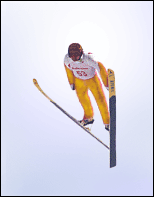
Winter Olympics Memorable Moments: Eddie "the Eagle" Edwards
You know, I miss Eddie the Eagle.
He was the British Ski Jumper, who, well, couldn't really Ski Jump. It was more like he Ski Fell.
He had no chance of medalling, but competed anyway. He was a great example of someone participating in the sport for the sake of the sport.
Apparently, the IOC did not feel that was enough to justify a performance, and began requiring that most performers actually be good or qualified. I can't blame them really. It is supposed to be the best of the best, and if I could participate that would really sully it a bit.
Still, who doesn't want to cheer for the underdog.
2006-02-19
I Want to See Play Cole
Today, I am pleased to announce the launch of the much anticipated Play Cole home page.
Visit http://www.playcole.com to see videos, catch up on the latest Play Cole news, and learn more about these four brilliant comedians.
The feature video for the launch is Planet of the Apes: Behind the Grunts. This is the online premiere of the Play Cole classic.
After you watch the video, follow the link to YouTube.com, where you can rate the video, and suggest they feature it on their main page.
Visit http://www.playcole.com to see videos, catch up on the latest Play Cole news, and learn more about these four brilliant comedians.
The feature video for the launch is Planet of the Apes: Behind the Grunts. This is the online premiere of the Play Cole classic.
After you watch the video, follow the link to YouTube.com, where you can rate the video, and suggest they feature it on their main page.
2006-02-18
Sometimes the joke walks right past you
My girlfriend and I were sitting in Starbucks today when she noticed a man walk by the window carrying 2 dozen eggs.
While I doubt I would get an answer, I wanted to ask him, "Why are you carrying 2 dozen eggs?"
A1: Because they're too young to walk.
A2: Because I would look silly juggling them down the street.
A3: I'd roll them, but this isn't the Whitehouse Lawn.
A4: Have you ever tried pulling them?
A5: Because I couldn't carry three dozen.
A6: I lost a bet.
A7: I won a bet.
A8: I accidentally killed the chicken.
A9: You should see the other guy.
A10: What eggs?
A11: I always wanted to be named Benedict.
A12: I'm part of a support group for those who haven't come out of their shell.
A13: Because you're not supposed to put them all in one basket.
A14: My pockets are full of bacon.
A15: Because if I didn't, that would mean the terrorists have won.
While I doubt I would get an answer, I wanted to ask him, "Why are you carrying 2 dozen eggs?"
A1: Because they're too young to walk.
A2: Because I would look silly juggling them down the street.
A3: I'd roll them, but this isn't the Whitehouse Lawn.
A4: Have you ever tried pulling them?
A5: Because I couldn't carry three dozen.
A6: I lost a bet.
A7: I won a bet.
A8: I accidentally killed the chicken.
A9: You should see the other guy.
A10: What eggs?
A11: I always wanted to be named Benedict.
A12: I'm part of a support group for those who haven't come out of their shell.
A13: Because you're not supposed to put them all in one basket.
A14: My pockets are full of bacon.
A15: Because if I didn't, that would mean the terrorists have won.
2006-02-17
The best view of Seattle
I caught a 7:45 AM flight from IAD (Dulles airport outside of Washington, DC) to Seattle this morning. With the time zones, we landed in Seattle at about 10:30.
These past few days, Seattle has been having one of those rare sun bursts for February. When the clouds go away, so does the heat, so it's a nice, chilly 40 degrees. Actually, that was the temperature in my apartment, but that's what sweaters and blankets are for.
With the clouds gone, and the sun shining through, the view of the city and mountains is brilliant. The colors and textures of the mountains and landscape pop on days like this.
One of the best things about flying into Seattle, is that about 2/3 of the time the planes land from the north and fly in over the city. They often come in either from over the sound to the west, or over the lakes to the east. Then they turn south and fly straight down I-5 and over downtown. The planes are low enough at the point that passengers have amazing views of downtown. You can pick out Greenlake, the Ballard Bridge, the Aurora Bridge, Paul Allen's Experience Music project, and the Convention Center.
Today, I could even pick out my aprtment building from the plane. No one was in the hot tub.
From the plane it looks like you could roll down the window and touch the Space Needle, the Smith Tower, and Columbia tower. During a game, you can see the crowds in Qwest Field or Safeco field, before continuing over the port. As you continue to descend, you may fly over a King5 helicopter landing at Boeing field, it's logo colors, brilliant against the morning light.
The final couple thousand feed get kind of dull. And then you're at the airport wondering what people hope to gain by unhooking their seatbelt and getting up 10 seconds before the light goes off.
Flying back into Seattle is the most consistently amazing approach I've seen from an aircraft.
These past few days, Seattle has been having one of those rare sun bursts for February. When the clouds go away, so does the heat, so it's a nice, chilly 40 degrees. Actually, that was the temperature in my apartment, but that's what sweaters and blankets are for.
With the clouds gone, and the sun shining through, the view of the city and mountains is brilliant. The colors and textures of the mountains and landscape pop on days like this.
One of the best things about flying into Seattle, is that about 2/3 of the time the planes land from the north and fly in over the city. They often come in either from over the sound to the west, or over the lakes to the east. Then they turn south and fly straight down I-5 and over downtown. The planes are low enough at the point that passengers have amazing views of downtown. You can pick out Greenlake, the Ballard Bridge, the Aurora Bridge, Paul Allen's Experience Music project, and the Convention Center.
Today, I could even pick out my aprtment building from the plane. No one was in the hot tub.
From the plane it looks like you could roll down the window and touch the Space Needle, the Smith Tower, and Columbia tower. During a game, you can see the crowds in Qwest Field or Safeco field, before continuing over the port. As you continue to descend, you may fly over a King5 helicopter landing at Boeing field, it's logo colors, brilliant against the morning light.
The final couple thousand feed get kind of dull. And then you're at the airport wondering what people hope to gain by unhooking their seatbelt and getting up 10 seconds before the light goes off.
Flying back into Seattle is the most consistently amazing approach I've seen from an aircraft.
2006-02-15
How do you start writing
It's not important what you write. It's important that you write.
That's one of the main lessons I learned in high school. In my senior year, Mr. Vellucci, my English teacher emphasized the importance of writing. The best way to get past writer's block and begin writing, was just to begin writing. About what did not matter. Just start writing and edit later.
This thought also occurs in Robert Pirsig's "Zen and the Art of Motorcycle Maintenance". One of the English professor's students gets stumped in a writing class. The professor tells the student to just start writing, but the student says they can't come up with anything to write about. The professor points out the window to a brick building, and then points to an ordinary brick in the building. The professor then tells the student to write about that brick, and, when finished, to write about the brick next to it.
One thing that also came out of Mr Vellucci's class (though it could have been another) was that whenever writing a paper or an essay, the first thing I should do when I begin editing was to simply delete my first paragraph. Regardless of what was in it, deleting that paragraph would be a good idea. Naturally, I was arrogant enough to think I could always write a good first paragraph, but I was wrong. Invariably, my writing was always better when I deleted the first paragraph. The first was was really nothing more than a warm up. In the later paragraphs was when I actually started communicating ideas.
Today, this still comes in to play. At work I produce various proposals, training documents, and presentations. I will often get stuck, however. When I am trying to manage multiple projects and competing deadlines, it is very easy to get stuck trying to do it right and end up with nothing to show for it.
The trick is take one project at a time and just start writing the content for it.
The most powerful force in the universe, besides compound interest, is the power of editing.
Editing gives me the freedom to not worry about doing it right in the first draft. I can produce material that is boring, poorly structured, unoriginal, ugly, confusing, or just wrong. Then I have something to work with. I can fix the problems and improve on it. Once I start on something with the expectation that I will edit it, then it doesn't matter if I get it right at first.
However, once I start on this process, without the pressure of trying to be perfect, then magic starts to happen. Ideas come to me. Words begin to flow. I am free-er to try different things and experiment. The trick is to just get started.
The important thing is not what you write.
The important thing is that you write.
That's one of the main lessons I learned in high school. In my senior year, Mr. Vellucci, my English teacher emphasized the importance of writing. The best way to get past writer's block and begin writing, was just to begin writing. About what did not matter. Just start writing and edit later.
This thought also occurs in Robert Pirsig's "Zen and the Art of Motorcycle Maintenance". One of the English professor's students gets stumped in a writing class. The professor tells the student to just start writing, but the student says they can't come up with anything to write about. The professor points out the window to a brick building, and then points to an ordinary brick in the building. The professor then tells the student to write about that brick, and, when finished, to write about the brick next to it.
One thing that also came out of Mr Vellucci's class (though it could have been another) was that whenever writing a paper or an essay, the first thing I should do when I begin editing was to simply delete my first paragraph. Regardless of what was in it, deleting that paragraph would be a good idea. Naturally, I was arrogant enough to think I could always write a good first paragraph, but I was wrong. Invariably, my writing was always better when I deleted the first paragraph. The first was was really nothing more than a warm up. In the later paragraphs was when I actually started communicating ideas.
Today, this still comes in to play. At work I produce various proposals, training documents, and presentations. I will often get stuck, however. When I am trying to manage multiple projects and competing deadlines, it is very easy to get stuck trying to do it right and end up with nothing to show for it.
The trick is take one project at a time and just start writing the content for it.
The most powerful force in the universe, besides compound interest, is the power of editing.
Editing gives me the freedom to not worry about doing it right in the first draft. I can produce material that is boring, poorly structured, unoriginal, ugly, confusing, or just wrong. Then I have something to work with. I can fix the problems and improve on it. Once I start on something with the expectation that I will edit it, then it doesn't matter if I get it right at first.
However, once I start on this process, without the pressure of trying to be perfect, then magic starts to happen. Ideas come to me. Words begin to flow. I am free-er to try different things and experiment. The trick is to just get started.
The important thing is not what you write.
The important thing is that you write.
2006-02-13
A first from all my years of travel

I've flown through well over 40 airports in the past 6 years. Today however, was the first and only time I've flown through ATL -- Atlanta Hartsfield airport.
This is really unusual for the business traveler. Approximately 95% of flights in this country arrive at or depart from Atlanta. 4% of the remaining flights are delayed at O'Hare (ORD) and the remain flights are stuck on the tarmac waiting for a gate at JFK.
But today, I finally flew through ATL. This airport is the busiest in the country and has achieved mythic status in the lore of the business traveler. It supposed to be the biggest, busiest, best, and most annoying airport in the country.
Now that I've been there, I can say without a doubt that they need to clean their carpets. Really. They're dingy and sort of faded gray-beige. Really, airport authority, call someone. They'll come out and do it for you.
And by the way, there are no mermaids in the Atlanta airport.
Yes, I have a BA from Yale, an MA from Harvard, and a PhD from Oxoford. I'd be happy to make your frys.
Inflating a resume a crime? It might be under new bill
It may soon be illegal to lie on a resume about degrees. It seems the Washington legislature is about to make it against the law for people to claim to have a degree the don't have, or to claim a degree from an unaccredited University without disclosing that it is unaccredited.
I'm torn about this. Naturally, it is not a good idea to falsify a degree. If someone finds out, it can be career suicide. People have been fired years down the road for lying during the application process.
But do we really need legislation that addresses this issue? Is it so wide spread that the state needs to be fining people?
Perhaps there is a middle ground. While I'm not sure the state should be fining people over this, it is clearly fraudulent. Employers who hire people, and then learn they falsified the credential should probably sue for fraud. I supposed if someone claimed to graduate from an institution, when in fact they didn't, perhaps the school can sue for libel.
If we are going to put legal restrictions on employees requiring them to represent themselves accurately, should similar requirements be placed on employers? Should they be allowed to change the nature of the job after offering it to the employee? If not, how long should they be required to maintain the original position?
If folks are simply honest in the interview and application process, we can see better employment matches all around.
It may soon be illegal to lie on a resume about degrees. It seems the Washington legislature is about to make it against the law for people to claim to have a degree the don't have, or to claim a degree from an unaccredited University without disclosing that it is unaccredited.
I'm torn about this. Naturally, it is not a good idea to falsify a degree. If someone finds out, it can be career suicide. People have been fired years down the road for lying during the application process.
But do we really need legislation that addresses this issue? Is it so wide spread that the state needs to be fining people?
Perhaps there is a middle ground. While I'm not sure the state should be fining people over this, it is clearly fraudulent. Employers who hire people, and then learn they falsified the credential should probably sue for fraud. I supposed if someone claimed to graduate from an institution, when in fact they didn't, perhaps the school can sue for libel.
If we are going to put legal restrictions on employees requiring them to represent themselves accurately, should similar requirements be placed on employers? Should they be allowed to change the nature of the job after offering it to the employee? If not, how long should they be required to maintain the original position?
If folks are simply honest in the interview and application process, we can see better employment matches all around.
2006-02-12
Have a beer with Conan O'Brien or Nelly?
As Jon and I were discussing the future of Play Cole today, it occurred to me that it is much easier to be supportive of friends in comedy than in music. I imagine this applies to theater and similar activities as well.
Music can be a more polarizing element for people. Or rather a sharply distinctful one. The continuing decline of Top 40 radios is emblematic of that. Popular music has divided into several rigid genres, each with its own audience. And beyond the world of popular music, the other genres (country, classical, jazz, soft jazz, world, angry, etc.) each have their own very specific fan bases. While many people my follow more than one genre, they are not likely to be fans of all of it.
The point is that even when someone is good at making music, that music will not be liked by a large number of people; those outside the genre simply won't enjoy it. They may be appreciate the technical proficiency a performer brings to a task, but appreciating technical proficieny is not what want to do after a long day at work.
Thus, when people tell me they are in a band. I think that's great. I may be interested in seeing a performance, but that doesn't necesarily mean I will like what I see, or that it is, in my view, entertaining.
Comedy is different, however. It is easier to go see. And when someone is technically proficient at comedy, it's going to be funny, pretty much by definition. Thus, when seeking entertainment, comedy is more likely to deliver than an associate's music.
So where does theater fall in? Some where in between I imagine. But I'm not going to explore that today.
Appreciating comedy has a lower barrier of entry. It's also easier to laugh. Plus, people tend to get angry when you laugh at their music.
Music can be a more polarizing element for people. Or rather a sharply distinctful one. The continuing decline of Top 40 radios is emblematic of that. Popular music has divided into several rigid genres, each with its own audience. And beyond the world of popular music, the other genres (country, classical, jazz, soft jazz, world, angry, etc.) each have their own very specific fan bases. While many people my follow more than one genre, they are not likely to be fans of all of it.
The point is that even when someone is good at making music, that music will not be liked by a large number of people; those outside the genre simply won't enjoy it. They may be appreciate the technical proficiency a performer brings to a task, but appreciating technical proficieny is not what want to do after a long day at work.
Thus, when people tell me they are in a band. I think that's great. I may be interested in seeing a performance, but that doesn't necesarily mean I will like what I see, or that it is, in my view, entertaining.
Comedy is different, however. It is easier to go see. And when someone is technically proficient at comedy, it's going to be funny, pretty much by definition. Thus, when seeking entertainment, comedy is more likely to deliver than an associate's music.
So where does theater fall in? Some where in between I imagine. But I'm not going to explore that today.
Appreciating comedy has a lower barrier of entry. It's also easier to laugh. Plus, people tend to get angry when you laugh at their music.
2006-02-11
"...I've signed legislation that will outlaw Russia forever."
I love it when Presidents forget they're MIC'ed.
Oops! - Bush unaware mikes were still on:
Probably the least contraversial thing the President said this week.
Oops! - Bush unaware mikes were still on:
"'I want to share some thoughts with you before I answer your questions,' Bush began. 'First of all, I expect this conversation we're about to have to stay in the room. I know that's impossible in Washington.'"
Probably the least contraversial thing the President said this week.
2006-02-09
The Former Mr. Ed is back
Love Monkey Home Page
Is anyone else watching this show? I haven't checking the ratings lately, but somehow I have caugh 3 episodes on live TV so far.
It stars Tom Cavanagh, perhaps best know for his starring roll in "Ed", another quirky TV show that seemed to develop a strong cult following, although somehow I never caught it.
In "Love Monkey" Cavanagh plays Tom Farrell, an A and R rep for an independent music label, charged with finding and promoting new talent.
I'm not sure why I like this show, but I do. Farrell's internal monologue drives the show and nearly the whole show is told form his perspective. There are bits where we learn more about his friends out side of his perspective underneath his internal monologue.
It's touching without being too syrup-ey. It covers the tension around growing up (as an adult). It also explores the necessary tension between music as art, music as business, and music as obsession.
Overall, it seems to strike a nice, gentle, and interesting chord while not going overboard on the sappy or sweet.
Well, I had this post ready to go. Then I heard the show might be cancelled after just 4 well done episodes. Posters on several forums claim the show is cancelled. I have not been able to verify that, however.
This is a show that has legs. It's got compelling, likable carries, and it should be allowed to survey. More and more often, however, the networks aren't giving these shows a chance. Jon discussed this a couple weeks back, too.
It's frustrating because so many good shows over the years would never have survived in today's environment. Shows like Star Trek, Seinfeld, Cheers, Cagney and Lacey are just a few that come to mind. If given time good story telling makes for good TV. Instead of more episodes of this refreshing series, we are likely to get reruns of NCIS, which is not a bad show, but it's not the same.
Subscribe to:
Posts (Atom)
