
- Tokyo Travels Part 01: Almost Home
- Tokyo Travels Part 02: Strolling the Ginza
- Tokyo Travels Part 03: Visiting the Tsukiji Fish Market
- Tokyo Travels Part 04: Graffiti
- Tokyo Travels Part 05: Hamarikyu Garden
- Tokyo Travels Part 06: Fraking Cylons on the Sumida River
- Tokyo Travels Part 07: Safety in Starbucks
- Tokyo Travels Part 08: Hato Bus Tour
- Tokyo Travels Part 09: Tokyo Tower
- Tokyo Travels Part 10: Tea Ceremony
- Tokyo Travels Part 11: Lunch at Chinzan-so
- Tokyo Travels Part 12: Imperial Palace
- Tokyo Travels Part 13: Sumida River Cruise
- Tokyo Travels Part 14: Asahi Breer Hall
- Tokyo Travels Part 15: Escalator Discipline
- Tokyo Travels Part 16: Sensoji Temple and Nakamise-dori
- Tokyo Travels Part 17: Harajuku Area
- Tokyo Travels Part 18: Meiji Jingu
- Tokyo Travels Part 19: Wandering Shibuya
- Tokyo Travels Part 20: Tower Records
- Tokyo Travels Part 21: Conrad Tokyo
- Tokyo Travels Part 22: The Prostitutes
- Tokyo Travels Part 23: Ometesando and Shibuya Redux
2010-05-22
Tokyo Travels Index


Tokyo Travels Part 01: Almost Home

View from the Conrad Tokyo Room 3602
As I write this, I'm watching a KLM 747 taxi across the tarmac at LAX. I love their blue paint job. We've got a great view from the AS Boardroom, and are more than halfway though a 6 hour layover. Another 970 miles or so and we'll be home.
The GF and I just flew back from a great trip to Tokyo. It's an amazing place with some fantastic people and great energy. On top of that, for a city of 12 million people, it is remarkably clean and safe. In the coming weeks, I'll share more details and stories.
Here are some numbers from the trip:
- Ticket cost: 250,000 AS miles
- Photos and videos: 22.5GB
- ORD Flight delay: 3 hours
- Trip length: 9 days
- Cameras lost: 1
- Cameras found: 1
- AMEX Fraud alerts triggered: 1
- Nights with room service: 2
- Traffic accidents seen: 0
- Time to deal with NRT Customs: 20 seconds
- Time to deal with LAX Customs: 8 seconds
- Other Passengers in First Class cabin (ORD--> NRT): 4
- Other Passengers in First Class cabin (NRT--> LAX):14
- Train lines ridden: 3
- Schoolgirl Ninjas we saw: 0 (that we know of)
- Weight lost: 05 Lbs
- Trips to McDonalds: 2
- "Squished Penny Machines": 7
- Earliest hotel departure: 4:15 AM for Tsukiji
- Number of people in line ahead of us by 4:45 : 100
- Godzilla sitings: 0
- Stray cat sitings: 1
- CC Lemon Sodas consumed: 6
- Vending machine coffee beverage cans now in checked baggage: 3
- Plush toys acquired (friends for Miles): 7
- Number that are a robot: 1

Statue of Liberty over on Odaiba Island in Tokyo Bay
2010-05-20
Book Review 56: Blind Willow Sleeping Woman

All the stories you've been telling tonight seem to fall into two categories. There's the type where you have the world of the living on one side, the world of death on the other and some force that allows a crossing-over from one side to the other. This would include ghosts and the like. The second type involves paranormal abilities, premonitions, the ability to predict the future. All of your stories belong to one of these two I groups.
Page 55
I’m sitting on a 777 as I write this, cruising somewhere over the Pacific Ocean on my way to Tokyo. I suppose it’s only fitting that I use this moment, and my remaining 2 hours of battery life, to make sense of another Haruki Murakami book – Blind Willow sleeping Woman.
“Make sense of” may be setting the bar too high. I love bathing in Murakami’s words. But it’s bathing in a river, instead of a tub. And you have to let the currents take you where they will. Put aside preconceived notions of a story that has a beginning, middle, and end because most Murakami stuff does not have that. Set aside the expectations and go along for the ride.
I enjoyed this book and most of the short stories in it. The plots are not the central elements of the stories – the characters and writing are. If you are okay with that, then I recommend Blind Willow Sleeping Woman.
Almost everything Murakami writes is about loneliness. You’ll see that theme echoed throughout these pages. Characters with friends, relationship, and spouse all still feel a profound loneliness and dissociation from the world.
Rather than trying to do a comprehensive review of how everything fits together in this book (which might be a good idea for a college lit class) I’ll simply share some thought and favorite passages from a few of the various short stories. There are other excellent ones in the book that I am not commenting on.
Introduction
Yes, the part of the book people generally gloss over has some good stuff. In it, Murakami talks about what he enjoys about writing, and compares short stories to novels.
To put it in the simplest possible terms, I find writing novels a challenge, I find writing short stories a joy. If writing novels is like planting a forest, then writing short stories is more like planting a garden. The two processes complement each other, creating a complete landscape that I treasure. The green foliage of the trees casts a pleasant shade over the earth, and the wind rustles the leaves, which are sometimes dyed a brilliant gold. Meanwhile, in the garden, buds appear on flowers, and colorful petals attract bees and butterflies, reminding us of the subtle transition from one season to the next.
Page VII
He also explains the genesis of several stories in the book. I found myself flipping back to the Introduction often while reading just to get some context for the story.
This book naturally contains some stories I wrote after The Elephant Vanishes appeared. "Birthday Girl," "Man-Eating Cats," "The Seventh Man,' and "Ice Man" are some of these. I wrote "Birthday Girl" at the request of the editor when I was working on an anthology of other writers' stories on the theme of birthdays. It helps to be a writer when you're selecting stories for an anthology, since if you're short one story you can write one yourself. "Ice Man," by the way is based on a dream my wife had, while "The Seventh Man" is based on an idea that came to me when I was into surfing and was gazing out at the waves.
Page IX
Often when reading a short story by Murakami, I’ll think, “This seems familiar.” I’ll have the same reaction with some of his novels. And it makes sense because he often draws from one to complete another.
There was a period when narratives I'd written as short stories, after I'd published them, kept expanding in my mind, developing into novels. A short story I'd written long ago would barge into my house in the middle of the night, shake me awake, and shout, "Hey, this is no time to be sleeping! You can't forget about me, there's still more to write!" Impelled by that voice, I'd find myself writing a novel. In this sense, too, my short stories and novels connect up inside me in a very natural, organic way
Page X
Blind Willow Sleeping Woman
This is a story about family and friends and dying too young. There’s a lot in this one and it is just beyond my reach.
The Birthday Girl
This is a fascinating story about wishes and eccentrics. I wanted to learn more, but as I expected just when I most wanted answers there were none.
Still, I loved this description:
She spoke only when necessary and always wore the same black dress. There was something cold and hard about her: if you set her afloat on the nighttime sea, she would probably sink any boat that happened to ram her.
Page 20
The Mirror
This quasi-horror story contains this great gem on aging and maturing.
Anyway, there I was each night at nine and three, making my rounds, a flashlight in my left hand, a wooden kendo sword in my right. I'd practiced kendo in high school and felt pretty confident in my ability to fend off anyone. If an attacker was an amateur, and even if he had a real sword with him, that wouldn't have scared me. I was young, remember. If it happened now, I'd run like hell.
Page 57
Hunting Knife
Who hasn’t been at that awkward part of a conversation where you want to leave but you’re not sure if you should?
He was silent for thirty seconds, maybe a minute. I uncrossed my legs under the table and wondered if this was the right moment to leave. It was as if my whole fife revolved around trying to judge the right point in a conversation to say goodbye. But I missed my chance: just as I was going to tell him I had to go, he spoke up.
Page 89
A Perfect Day for Kangaroos
in this story about a trip to the zoo, and character is overwhelmed by his girlfriend.
"Yeah, but look," I shot back, "I've never seen a giraffe give birth, or even whales swimming, so why make such a big deal about a baby Kangaroo?"
'Because it's a baby kangaroo," she said. "That's why.'
I gave up and started leafing through the newspaper. I'd never once won an argument with a girl.
Page 96
The Seventh Man
This story of personal redemption by confronting the past includes:
I stopped having my terrible nightmares. I no longer wake up screaming in the middle of the night. And I am trying to start life over again. No, I know it's probably too late to start again. I may not have much time left to live. But even if it comes too late, I am grateful that, in the end I was able to attain a kind of salvation, to effect some sort of recovery. Yes, grateful: I could have come to the end of my life unsaved, still screaming in the dark, afraid.
Page 167
The Year of Spaghetti
This story gives use these great lines.
As a rule I cooked spaghetti, and ate it, alone. I was convinced that spaghetti was a dish best enjoyed alone. I can't really explain why I felt that way, but there it is.
Page 169
When the phone rang at three twenty I was sprawled out on the tatami. staring at the ceiling. A pool of winter sunlight had formed in the place where I lay. Like a dead fly I lay there, vacant, in a December 1971 spotlight.
At first, I didn't recognize it as the phone ringing. It was more like an unfamiliar memory that had hesitantly slipped in between the layers of air. Finally, though, it began to take shape, and, in the end, a ringing phone was unmistakably what it was. It was one hundred percent a phone ring in one-hundred-percent-real air. Still sprawled out, I reached over and picked up the receiver.
Page 171
Thinking about spaghetti that boils eternally but is never done is a sad, sad thing.
Page 173
Can you imagine how astonished the Italians would be if they knew that what they were exporting in 1971 was really loneliness?
Page 173
The Iceman
The Iceman is a story about loneliness when a woman falls in love with a man essentially made of ice.
You're not skiing? I asked, trying to sound casual. The Ice Man slowly raised his head, looking like he was carefully listening to the wind blowing far away He gazed intently at me and then quietly shook his head. I don't ski, he said. I'm fine just reading and looking out at the snow. His words floated up in the air, a white comic-book bubble of dialogue, every word visible before me. He gently wiped away some of the frost from his fingers.
Page 200
How about the South Pole? I said. I picked the South Pole because I was sure the Ice Man would be interested in going there. And, truth be told, I'd always wanted to go see it. To see the aurora, and the penguins. I had this wonderful mental picture of myself in a hooded parka underneath the aurora, playing with the penguins.
Page 204
Then I wake up and find the Ice Man sleeping beside me. He makes no sound as he sleeps, like something frozen and dead. I love him, though. I start to cry, my tears wetting his cheeks. He awakens and holds me close. I had an awful dream, I tell him. In the darkness he slowly shakes his head. It was only a dream, he says. Dreams come from the past, not from the future. Dreams shouldn't control you—you should control them.
Page 205
Chance Traveler
This is a story about the magical coincidence – that moment when the world lines up just right to give you an unexpected and joyous moment. Murakami seems to be talking about serendipity though he doesn’t use the word. But that's all I could think of as a read this tale.
It seems obvious to me that this is what the story is about, and yet it never appears in the text. I wonder if that’s because it’s a concept I’m looking for and that Murakami is not, or if this is a case of linguistic challenges. Murakami writes in Japanese and then his translators go to work. Is it possible there’s no word in Japanese that corresponds directly to serendipity and therefore the story was not structured around it? Or perhaps I’m just over thinking things.
Regardless, this is one of my favorite stories in the book. Perhaps because it doesn’t make my head spin as much, but also because I love the characters and the way they are dealing with the challenges they face.
Over his long career Tommy Flanagan has played and recorded countless pieces as a sideman in various groups, but it was the crisp, smart solos, short though they were, in these two particular pieces that I've always loved. That's why I was thinking if only he would play those two numbers right now it'd be perfect. I was watching him closely, picturing him coming over to my table and asking, "Hey, I've had my eye on you. Do you have any requests? Why don't you give me the titles of two numbers you'd like me to play?" Knowing all the time, of course, that the chances of that happening were nil.
And then, without a word, and without so much as a glance in my direction. Tommy Flanagan launched into the last two numbers of his set—the very ones I'd been thinking of. He started off with the ballad 'Star-Crossed Lovers," then went into an up-tempo version of "Barbados. I sat there, wineglass in hand, speechless. Jazz fans will understand that the chance of his picking these two pieces from the millions of jazz numbers out there was astronomical. And also—and this is the main point here—his performances of both numbers were amazing.
The second incident took place around the same time, and also had to do with jazz. I was in a used-record store near the Berkley School of Music one afternoon, checking out the records. Rummaging around in old shelves of LPs is one of the few things that makes life worth living, as far as I'm concerned. On that particular day I'd located a used copy of Pepper Adams's recording for Riverside called 10 to 4 at the 5 Spot. It was a live recording live recording of the Pepper Adams Quintet, with Donald Byrd on trumpet, recorded in New York at the Five Spot jazz club, "1o to 4," of course, meant ten minutes till four o'clock, meaning that they played such a hot set they went on till dawn. This copy of the album was a first pressing, in mint condition, and was going for only seven or eight dollars. I owned the Japanese version of the record and had listened to it so much it was all scratched. Finding an original recording in this good shape and at this price seemed, to exaggerate a little, like a minor miracle. I was overjoyed as I bought the record, and just as I was exiting the shop a young man passed me and asked, "Hey, do you have the time?" I glanced at my watch and automatically answered, "Yeah, it's ten to four."
Page 237-238
"The music world is where child prodigies go to die," he said as he ground some coffee beans. "Having to give up the idea of being a professional pianist was a major disappointment. It was like everything I'd done up till then was a complete waste. I just wanted to disappear. But it turned out my ears are superior to my hands. There are a lot of people more talented than me, but nobody has as good an ear. I realized that not long after I started college. And that being a first-class piano tuner was a lot better than being a second-rate pianist."
Page 248
'That's right," he said, and nodded several times. "That's the key. And is a pretty common thing after all. Those kinds of coincidences are happening all around us, all the time, but most of them don't catch our attention and we just let them go by. It's like fireworks in the daytime. You might hear a faint sound, but even if you look up at the sky you can't see a thing. But if we're really hoping something may come true, it may become visible, like a message rising to the surface. Then we're able to make it out clearly, decipher what it means. And seeing it before us we're surprised and wonder at how strange things like this can happen. Even though there's nothing strange about it. I just can't help thinking that. What do you think? Is this forcing things?"
Page 251
Where I’m Likely to Find It
This story is one of the more typical Murakami stories in the book. In it, we have great use of language, a strange plot that is secondary to what’s happening, otherworldly elements, characters who just accept these things, and lots of loose ends.
"One of the reasons my husband bought this condo was that the stairs are wide and well lit," she said. "Most high-rise apartments skimp on the stairs. Wide staircases take up too much space, and, besides, most residents prefer the elevator. Condo developers like to spend their money places that attract attention—a library, a marble lobby. My husband, though, insisted that the stairs were the critical element—the backbone of a building, he liked to say."
I have to admit, it really was a memorable staircase. On the landing between the twenty-fifth and twenty-sixth floors, next to a picture window, there was a sofa, a wall-length mirror, a standing ashtray, and a potted plant. Through the window you could see the bright sky and a couple of clouds drifting by. The window was sealed and couldn't be opened.
Page 280
The old man shook his head and dropped his cigarette into the ashtray "As I'm sure you know, water always picks the shortest route to flow down. Sometimes, though, the shortest route is actually formed by the water The human thought process is a lot like that. At least, that's my impression. But I haven't answered your question. Mr. Kurumizawa and I never once talked about such deep things. We just chatted—about the weather, the apartment association's regulations, things of that nature."
Page 285
This is just a sampling of the great lines and stories in Blind Willow Sleeping Woman. I also loved A Shinagawa Monkey, The Kidney-Shaped Stone that Moves Every Day, Dabchick 101, Man-Eating Cats, and more.
Blind Willow Sleeping Woman is definitely worth a read, but be aware of what your getting into when you open the book. Don’t expect the plots and stories to wrap up neatly; enjoy them for what they are.
Other Murakami Book Reviews I’ve written:
-
Book Review 03: Dance Dance Dance
-
Book Review 06: The Elephant Vanishes
-
Book Review 23: Sputnik Sweetheart
-
Book Review 45: After Dark
You can read more of my book reviews here.
Here is the back cover synopsis of the book.
From the bestselling author of Kafka on the Shore and The Wind-up Bird Chronicles comes this superb collection of twenty-four stories that generously expresses Murakamis mastery of the form. From the surreal to the mundane, these stories exhibit his ability to transform the full range of human experience in ways that are instructive, surprising, and relentlessly entertaining.
Here are animated crows, a criminal monkey, and an iceman, as well as the dreams that shape us and the things we might wish for. Whether during a chance reunion in Italy, a romantic exile in Greece, a holiday in Hawaii, or in the grip of everyday life, Murakamis characters confront grievous loss, or sexuality, or the glow of a firefly, or the impossible distances between those who ought to be closest of all.
2010-05-18
Book Review 55: Soon I Will Be Invincible

When your laboratory explodes, lacing your body with a supercharged elixir, what do you do? You don't just lie there. You crawl out of the rubble, hideously scarred, and swear vengeance on the world. You keep going. You keep trying to take over the world.Soon I will be Invincible by Austin Grossman is a fun book that follows the adventures of a Supervillian as he tries to take over the word and a reluctant Superheroine as she struggles to fit in with a team of heroes determined to stop him.
Page 310
The novel takes place in a comic-book like world and opens with Dr. Impossible in prison contemplating the nature of villains.
This morning on planet Earth, there are one thousand, six hundred, and eighty-six enhanced, gifted, or otherwise-superpowered persons. Of these, one hundred and twenty-six are civilians leading normal lives. Thirty-eight are kept in research facilities funded by the Department of Defense, or foreign equivalents. Two hundred and twenty-six are aquatic, confined to the oceans. Twenty-nine are strictly localized—powerful trees and genii loci, the Great Sphinx, and the Pyramid of Giza. Twenty-five are microscopic (including the Infinitesimal Seven). Three are dogs; four are cats; one is a bird. Six are made of gas. One is a mobile electrical effect, more of a weather pattern than a person. Seventy-seven are alien visitors. Thirty-eight are missing. Forty-one are off-continuity, permanent emigres to Earth's alternate realities and branching timestreams.It’s a fun book that looks at the fate of, and illustrates the flaws with, villains and heroes in a more light-hearted way than we see in the iconic Watchmen or in the tortured souls of the Marvel Universe. We see meetings fall apart, misguided attempts at romance, and egos run amuck in a way that just seems more normal. The heroes’ organization seems more like a modern well intentioned corporate group than the almost sacred flawed heroes we’ve come to expect.
Six hundred and seventy-eight use their powers to fight crime. while four hundred and forty-one use their powers to commit them. Forty-four are currently confined in Special Containment Facilities for enhanced criminals. Of these last, it is interesting to note that an unusually high proportion have IQs of 300 or more -- eighteen to be exact. Including me.
Page 3-4
All superheroes have an origin. They make a big deal of it, the story of how they got their powers and their mission. Bitten by a radioactive bug, they fight crime; visited by wandering cosmic gods, they search for the lost tablets of so-and-so, and avenge their dead families. And villains? We come on the scene, costumed and leering, colorfully working out our inexplicable grudge against the world with an oversized zap gun or cosmic wormhole. But why do we rob banks rather than guard them? Why did I freeze the Supreme Court, impersonate the Pope, hold the Moon hostage?
Page 7-8
Grossman tells the story in first person perspective, primarily shifting back and forth between the Dr. Impossible, the villain, and Fatale, the heroine.
And is often the case, the villain is more interesting. Dr. Impossible talks about his conversation with another villain while in prison.
I stare back at him. I don't know where he got the idea I'm some kind of boss on the inside. The Prism talks to me sometimes, zaps in through the glass when no one's looking, but he's not making much sense these days. Spend too much time as a rainbow and you lose your grasp on certain things.Fatale faces her own challenges as a Cyborg (a human with who has had substantial portions of her body replaced with robotics).
Page 41
He leaves me alone to unpack. My room looks like a hotel— whoever lived here before me didn't do much decorating. Then I catch on—this must be Galatea's old room, the famous living robot. It figures.All good villains (I love that phrase) must take hostages at some point. The Dr. Impossible keeps kidnapping a hero’s girlfriend/reporter.
I don't like robots. I hate meeting them socially, even the smart ones that can paint pictures and talk about religion. I met XCathedra once, at a Washington reception connected to the high-tech industry. She was there, schmoozing with cybernetics executives who crowded around her like dwarves around Snow White. She was painted in white racing stripes for the occasion. 1 found myself looking at her shoulder joint, wondering whether we had any technologies in common. When our eyes met the feeling was uncomfortably intimate.
Page 54-55
"I was a superhero, too, for a while, but the NSA was just easier. It's not like how they tell you it will be. It's hard to make it on your own as a cyborg—I've tried, I weigh almost five hundred pounds. I can't find clothes that fit me. I can't ride a bicycle. I can't eat in a normal restaurant, or sit in a chair not reinforced for my weight. I need special foods; I need medication to keep my body from rejecting the implants, and then I get sick too often due to a depressed immune system.
Page 274
In later years, true, we drifted apart. You can't just take the same hostage every time. Not that my dating techniques grew any more sophisticated in the meantime. But she must be out there somewhere. I'm still waiting for that interview.Of course the Dr. Impossible escapes early in the novel. There wouldn’t be much of a story if he didn’t. Later on, some of the heroes encounter him at a coffee shop. As you would expect by this point in the book, they must follow comic book tradition and protocols.
Page 231
"You're an escaped felon. We're giving you a chance to surrender quietly. This doesn't have to be a fight."Overall, Soon I Will be Invincible was a fun read. It may not be a fantastic novel; it lacks the depth of many of my favorite books, but I got a big kick out of it. It’s humorous and despite the dark things that happen in the book, it’s still somewhat light-hearted. I found myself invested with the characters.
This sort of offer is a mere formality for a man with a Power Staff and a napkin taped to his face, and she knows it. I'm sweating, wishing I had my helmet. I promised myself once that I wouldn't go down in street clothes.
Page 193
It simultaneously satirizes and honors the superhero and comic book story telling.
If you are compiling your summer vacation reading list, and you like the superhero world, Soon I Will be Invincible by Austin Grossman should be on your list.
You can find more of my book reviews here.
Here is the back cover synopsis of Soon I Will be Invincible by Austin Grossman.
Doctor Impossible — evil genius, diabolical scientist, wannabe world dominator — languishes in a federal detention facility. He's lost his freedom, his girlfriend, and his hidden island fortress.
Over the years he's tried to take over the world in every way imaginable: doomsday devices of all varieties (nuclear, thermonuclear, nanotechnological) and mass mind control. He's traveled backwards in time to change history, forward in time to escape it. He's commanded robot armies, insect armies, and dinosaur armies. Fungus army. Army of fish. Of rodents. Alien invasions. All failures. But not this time. This time it's going to be different...
Fatale is a rookie superhero on her first day with the Champions, the world's most famous superteam. She's a patchwork woman of skin and chrome, a gleaming technological marvel built to be the next generation of warfare. Filling the void left by a slain former member, we watch as Fatale joins a team struggling with a damaged past, having to come together in the face of unthinkable evil.
Soon I Will Be Invincible is a thrilling first novel; a fantastical adventure that gives new meaning to the notions of power, glory, responsibility, and (of course) good and evil.
2010-05-16
Book Review 54: The Eyre Affair
The Special Operations Network was instigated to handle policing duties considered either too unusual or too specialized to be tackled by the regular force. There were thirty departments in all, starting at the more mundane Neighborly Disputes (SO-30) and going onto Literary Detectives (SO-27) and Art Crime (SO-24). Anything below SO-20 was restricted information, although it was common knowledge that the ChronoGuard was SO-12 and Antiterrorism SO-9. It is rumored that SO-1 was the department that polices the SpecOps themselves. Quite what the others do is anyone's guess. What'is known is that the individual operatives themselves are mostly exmilitary or ex-police and slightly unbalanced. "If you want to be a SpecOp," the saying goes, "act kinda weird.”
MILLON DE FLOSS
—A Short History of the Special Operations Network
Page 1
The Eyre Affair">The Eyre Affair is Jasper Fforde’s first novel. It’s also first in a series of books that follow the adventures of Thursday Next, Literary Detective. I enjoyed it and look forward to reading more books in the series.
You may recall my earlier reviews of books in his Nursery Crimes series (The Big Over Easy and The Fourth Bear). Like those books, the Eyre Affair takes place in a world like ours, but with with a much thinner veil between fantasy and reality.
It’s a world where time travel is possible, and crimes can take place at various points in the time stream. It’s the ChronoGuards’ job to fix it. Next’s father is a member of that elite group though they now consider him an outlaw (if “now” even makes sense as a description for those who pop in and out in time).
"I was in 78 recently," he announced. "I brought you this."
He handed me a single by the Beatles. I didn't recognize the title.
"Didn't they split in '70?"
"Not always. How are things?"
Page 4
"Nelson and Wellington, two great English national heroes both being shot early on during their most important and decisive battles."
“What are you suggesting?"
"That French revisionists might be involved."
"But it didn't affect the outcome of either battle," 1 asserted. "We still won on both occasions!"
"I never said they were good at it."
Page 5
"Motorcycle's gone," remarked Colonel Rutter. His second-in-command grunted in reply. He didn't approve of non-Chronos attempting his work. They had managed to maintain the job mysticism for over five decades with the wages to suit; have-ago heroes could only serve to weaken people's undying trust in what they did. It wasn't a difficult job; it just took a long time. He had mended a similar rent in spacetime that had opened up in Weybridge's municipal park just between the floral clock and the bandstand. The job itself had taken ten minutes; he had simply walked in and stuck a tennis ball across the hole while outside seven months flashed by—seven months on double pay plus privileges, thank you very much.
Page 178-179
Their role and existence calls to mind the Temporal Cold War from Star Trek: Enterprise.
Artistic and Literary fans get into militant conflicts regarding their passion.
There was violence when surrealism was banned and there was violence as the same ban was lifted. Grubb continued his broadcast as he intercepted a policeman marching away a youth dressed in sixteenth-century garb with a faithful reproduction of the "Hand of God" from the Sistine chapel tattooed on his face.
Page 121
Beyond that, in this time stream England and Whales are hostile neighbors with a battlefield border between them, and England is still at war with Russia in the Crimea.
It’s not clear if those are due to an error in the time stream or not, but to the characters in the book they appear to be perfectly normal.
And while we are building a world with strange wars, time travel, literary riots, Shakespeare vending machines, seemingly invulnerable criminals, why not also throw in genetically engineered and cloned pets, along with vampires and werewolves?
They, plus blimp travel all make an appearance in this novel.
I’m unclear on whether or not the Fforde’s Nursery Crime novels exist in the same universe because the England of Jack Spratt’s world seems very different. With the time stream issues, however, anything is possible. And there are references to Spratt and his car in this book.
"Daft name," grumbled Mycroft. "Like Landen Parke-Laine, come to that. Can I get down? It's time for Jack Spratt's Casebook."
Page 105
The first occasion was on a road somewhere in the Home Counties. It looked like winter, and ahead of us a lime-green Austin Allegro estate pulled out from slip road. I swerved and drove past at great speed, sounding my horn angrily. That image collapsed abruptly and fragmented itself into the dirty hold of a ship. The car was wedged between two packing cases, the closest of which was bound for Shanghai.
Page 280
Fforde has a lot going on in the background of this novel, including random scenes that will no doubt come into play in later books. Yet astonishingly he makes it work. I would not have expected that and would not have recommended it to an author attempting to write a book like this. And I guess that’s why I write reviews as a hobby instead of writing novels as a profession.
This book centers around the rare ability for people to cross over into a novel. Once they are in that novel world, they become part of the story and their presence, of course, can change it. If they drop into the original manuscript, every copy printed will change to reflect their presence.
This first happens to Thursday Next when she is a little girl. She accidentally falls into Jane Eyre at the point where Jane and Rockefeller first meet.
The dog ignored the figure on the stile but stopped dead in his tracks when he saw me. His tail wagged enthusiastically and he bounded over, sniffing me inquisitively, his hot breath covering me in a warm cloak and his whiskers tickling my cheek. I giggled and the dog wagged his tail even harder. He had sniffed along this hedge during every single reading of the of the book for over 130 years, but had never come across anything that smelled so, well... real. He licked me several times with great affection. I giggled again and pushed him away, so he ran off to find a stick.
Page 67
I returned to the museum a few times after that but the magic never worked again. My mind had closed too much by the time I was twelve, already a young woman. I only ever spoke of it to my uncle, who nodded sagely and believed every word. I never told anyone else. Ordinary adults don't like children to speak of things that are denied them by their own gray minds.
Page 69
The rest of the book centers around a machine that let’s people go into novels and kidnap characters. If I get into anymore depth than that I’ll be in spoiler territory. You can refer to the publisher’s synopsis at the end of this post.
The great thing about this book, though, is not just the story. It’s about being immersed in this deep, wacky, off-kilter, and dark world that Fforde builds for us. He even throws in what appears to be references to The Watchmen in character names.
"I have with me Detective Inspector Oswald Mandias, Yorkshire CID. Tell me. Inspector, do you think this crime is in any way connected to the Chuzzlewit theft?"
Page 287
“What is there to forgive?" demanded Roch. “Forgive and concentrate on living. Life for you is short; far too short to allow small jealousies to infringe on the happiness which can be yours only for the briefest of times."
Page 303
The book doesn’t have the same refinement and polish we see in the The Big Over Easy and The Fourth Bear. Occasionally the plot can get a bit murky. That’s a reflection of this book being written earlier in Fforder’s career.
That’s said, it’s a fantastic book. It’s funny. It’s got compelling characters, surprising depth on some of the secondary characters, a fascinating story, and great writing. I have the next book in the Next series already on my shelf and look forward to cracking the cover.
If you enjoy reading weird things that turn the universe upside down then you should read The Eyre Affair">The Eyre Affair.
You can read more book review here.
Here is the back cover synopsis of The Eyre Affair.
Great Britain circa 1985: time travel is routine, cloning is a reality (dodos are the resurrected pet of choice), and literature is taken very, very seriously. Baconians are trying to convince the world that Francis Bacon really wrote Shakespeare, there are riots between the Surrealists and Impressionists, and thousands of men are named John Milton, an homage to the real Milton and a very confusing situation for the police. Amidst all this, Acheron Hades, Third Most Wanted Man In the World, steals the original manuscript of Martin Chuzzlewit and kills a minor character, who then disappears from every volume of the novel ever printed! But that's just a prelude.
Hades' real target is the beloved Jane Eyre, and it's not long before he plucks her from the pages of Bronte's novel. Enter Thursday Next. She's the Special Operative's renowned literary detective, and she drives a Porsche. With the help of her uncle Mycroft's Prose Portal, Thursday enters the novel to rescue Jane Eyre from this heinous act of literary homicide. It's tricky business, all these interlopers running about Thornfield, and deceptions run rampant as their paths cross with Jane, Rochester, and Miss Fairfax. Can Thursday save Jane Eyre and Bronte's masterpiece? And what of the Crimean War? Will it ever end? And what about those annoying black holes that pop up now and again, sucking things into time-space voids.
Suspenseful and outlandish, absorbing and fun, The Eyre Affair">The Eyre Affair is a caper unlike any other and an introduction to the imagination of a most distinctive writer and his singular fictional universe. Next up in the Thursday Next series: Lost in a Good Book">Lost in a Good Book. Read more about it at thursdaynext.com.
2010-05-14
Book Review 53: Darkness Calls
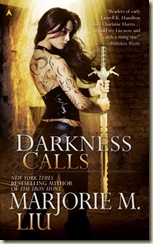
Trouble follows us, she said. No way to stop it, baby. You just deal with the hand, and play the cards, good and bad.I’ve either been picking the wrong books or have been excessively cranky lately because I’ve been a little disappointed with most of the books I’ve read the past few months, and Darkness Calls by Marjorie Liu is no exception.
Don't be afraid of mistakes. You'll make them.
Don't be afraid of yourself. Because you will be, sometimes.
Just have a little faith. Game isn't over until you're dead.
Page 150
Survival, though, was a daily process. One more day was all a person needed. Get enough of those, and you might have a lifetime.
Page 196
I really enjoyed Liu’s first book in the series, and this one has some great moments, but the story seems to bog down. It’s too bad, because I wanted to like it more. I enjoy her blog and it’s worth following her on Twitter. And I loved The Iron Hunt.
If you like The Iron Hunt, you should probably still read Darkness Calls. If you haven’t read The Iron Hunt, there’s not much point to reading Darkness Calls.
The series follows the adventures of Maxine Kiss and her 5 demonic tattoos. During the day, they live on her skin and make her invulnerable. Once the sunsets, the slide off and fight zombies and demons with Maxine. And they eat random junk while singing pop songs.
I grabbed his arm, and shoved him hard against the wall. He was strong. He resisted. But I was tougher than most men. I had to be, in order to bear the weight of the boys on my body—my boys who weighed the same, whether tattoo or flesh. Like Superman, surpassing earth's weak gravity. Fly, man, fly.Grant, Maxine’s Significant Other, can read auras and manipulate minds and emotions with his voice and flute. Maxine asked him what he sees when he looks at “the boys.”
Page 115
"A black rainbow," Grant replied, his fingers tightening. "Curving streaks of scales shaded with the deepest purple and obsidian flickering with shooting stars. I see night when they sing. I see the Aurora Borealis, but without color, as though their voices come from a place too ancient to have known anything but darkness."Maxine’s power is hereditary – passed from mother to daughter. And the daughter comers into her own once the mother dies. The demon tattoos leave the mother for the daughter.
"And yet, you trust them."
"There's nothing wrong with an absence of light. It's just another way of being. A different kind of energy."
page 130
Maxine’s ordinary battles have her fighting demons that possess people and do terrible things with their bodies. But the possessed aren’t always innocent victims.
Jack gave me a serious look. "You are the descendent of women who shook the world, my dear, and who entered the blood of human dreams. Wherever there are dark goddesses, and warrior queens, you will find yourself."
Page 253
"You needed clothes," I said tersely. "I don't feel the cold.""Thanks," she replied absently, rubbing her forehead. "I can hear your skin humming."
"It does that."
Page 273
I knelt by Archie and checked his pulse. Strong, steady. His eyelids fluttered, but he stayed unconscious, and I backed away quickly, rubbing my sweaty palms on my jeans. I had no way of knowing what this man had been like before being possessed, though I guessed he hadn't been the happy type. Stable, mentally robust people did not get possessed by demons. Too much work. No cracks to exploit.I reminds me of the Christian tradition of demonic possession. Theoretically, the devil cannot just possess anyone. The devil must be let in somehow.
page 5
There are some great things in this book. Liu has some fascinating place descriptions.
Concrete walls surrounded me. I was in a narrow alley that twisted like a crooked hair, and it was as lived-in as any old shoe. Battered doors lined the walls, framed by buckets and locked bicycles, and small wooden tables covered in newspapers. I saw windows cut in the stone, protected by iron bars, and cheap lights flickered shadows from within. I listened to pots bang, and smelled grease and rotting garbage, which were only slightly stronger than the I scent of ammonia. Above me, clotheslines strung across the alley were covered in sheets and underwear. Even farther beyond that, a craggy maze of tall apartment buildings filled the night sky so completely I could see only a sliver of a cloud.And, of course, the subtle Star Wars reference.
Page 95-96
You're not alone, she said. There are others.Okay, maybe it’s not a Star Wars reference exactly, but that’s what came to mind as I read those passages.
Page 188
All of us, together, I thought, heart still aching. Wondering what my mother would say—she, who had lived a life beyond mine, one I was learning about in fragments, and that painted a different picture of the woman I had thought I knew. I could still hear her voice in my head.
Trust yourself
You're not alone.
There are others.
Page 259
I also enjoyed the philosophical discussions about power, confidence and the general living of life while saving the world.
"I learned from my father," Grant said. "Same thing you learned from your mother, I suppose. Power is transient Power can flow from one person to another. The most powerful person in a room isn't the wealthiest or the one with the most connections. It's the person who believes the strongest, the one who has the most confidence. And, sometimes, it's the person who can make everyone else feel like less of themselves."I have two main problems with the novel.
Page 111
My grandmother had not been much of a writer .... But as I lay sprawled in the hall and prison of Mr. King, I was reminded of a rough note written on one of the last pages; a scrawled afterthought: The result of an act is always less damning than the thought that made it.
I did not agree.
Page 207
"One heart burns out," she breathed. "Two hearts live.'
Page 204
First, Liu has a tendency to describe what her characters are thinking by talking about how they stand or the looks on the faces. It feels like an expository short cut that’s overdone. It’s as though characters could have entire conversations by just shifting their positions and expressions without having any actual telepathic power. Perhaps it works better in a comic book where the reader has the visual keys of the art, but seems silly after a certain point in a novel.
My other major concern was the way Liu handles the exposition and background information Maxine will need to save the world. Some time has passed since the first novel and in that time, Maxine hasn’t learned much more about the cosmology of the world and nature of the battles she is fighting.
When the action heats up, the characters around her know more about what is going on but only let it out in dribs and drabs. I can understand Liu not wanting to spend pages pouring out the information to the reader. That makes sense. But the solution to that problem doesn’t make sense from a story telling perspective. There’s no reason someone shouldn’t just sit down with Kiss and teach her this stuff. Sure there’s a lot, but she is having to stumble over critical pieces of information that would have been really useful to know in advance.
There’s a lot to like in Darkness Calls, despite its flaws. I like the universe. I like Maxine and the people around her, and I want to see what happens next. I will read the next book in the series. Liu hooked me with the first novel. And I also liked the dedication:
For the nomads, the rootless, and the free ...I just wish I enjoyed the novel more.
- Dedication
You can see more of my book reviews here.
Here is the back cover synopsis:
They are the obsidian shadows of my flesh - tattoos with minds, hearts, and dreams. By day, they protect me. But when night calls to them, they leave my body, dissolving into their true form - as demons…
Nomad born and bred, demon hunter Maxine Kiss has always relied upon herself to fight the darkness that surrounds her, the predators-human, zombie, and otherwise - who threaten the earth. But one man has penetrated her lonely life: Grant, the last of his kind. With music he is able to control any living creature…including demons. And now his life is in danger.
Haunted by the past, determined to change the future, Maxine soon understands that to save Grant, she has only one choice-to lose control, and release her own powers of darkness…
2010-05-12
Book Review 52: The Stupidest Angel

Winter denial: therein lay the key to California Schadenfreude—the secret joy that the rest of the country feels at the misfortune of California. The country said: "Look at them, with their fitness and their tans, their beaches and their movie stars, their Silicon Valley and silicone breasts, their orange bridge and their palm trees. God, I hate those smug, sunshiny bastards!" Because if you're up to your navel in a snowdrift in Ohio, nothing warms your heart like the sight of California on fire. If you're shoveling silt out of your basement in the Fargo flood zone, nothing brightens your day like watching a Malibu mansion tumbling down a cli into the sea. And if a tornado just peppered the land around your Oklahoma town with random trailer trash and redneck nuggets, then you can find a quantum of solace in the fact that the earth actually opened up in the San Fernando Valley and swallowed a whole caravan of commuting SUVs.The Stupidest Angel by Christopher Moore takes us back to the well trod ground of Pine Cove, CA. We’ve been here before, in the Practical Demon Keeping and The Lust Lizard of Melancholy Cove. We meet familiar characters from those books plus characters from The Gospel According to Biff and The Island of Sequined Love Nun. And we they all get together, things get weird.
Page 163
The novel has Moore’s trademark humor, and I loved seeing Skinner and Roberto again. Unfortunately, the characters all seem less genuine and more wooden.
It’s like a Food Network Thanksgiving special. You see the promos and are excited to see all your favorite personalities in the same room. And yet when airs – when you see Emeril, Alton, Tyler, Paula, and Rachel talk about food with each other -- it all seems false and hallow.
And that’s what The Stupidest Angel is. It’s a Christopher Moore Christmas Special.
It’s funny and cute and disturbing and messed up, but it’s just not great. Moore has a lot of great books but this one is just good. Read his other stuff first.
That said, there are still some great moments in this book and some entertaining lines. Moore does make his displeasure with the Iraq War known in a tangent that helps with characterization without distracting too much from the plot.
Santa might understand, though, since he knew toys. But Mom would never buy it. He'd been playing Barbarian George's Big Crusade on the PlayStation at his friend Sam's house, and they'd gotten into the infidel territory and killed thousands of the 'Rackies, but the game just didn't have any way to exit. It wasn't designed so you could ever get out of it, and before he knew it, it was dark outside and he'd forgotten and Christmas just going to be ruined.The local constable and his psychotic, former B-Movie starlet wife are prominently featured in this book.
Page 34
'You cut it down with your sword?" Theo wasn't so worried about what she had cut it down with, but from where she'd cut it. He had a secret in the forest near their cabin.While this passage is a good illustration of their relationship, I’m not a big fan of where Moore takes them later in the book. It just doesn’t seem right. Or maybe it is right and I just wanted something better for them.
'Yeah. We don't have a chain saw that I don't know about, do we?'
"No." Actually they did, in the garage, hidden behind some paint cans. He'd hidden it when her "artistic" moments had been more frequent. "That's not the problem, sweetie. I think the problem is that it's too big."
Page 57-58
Skinner is Gabe’s dog. One of the best parts of this books is when we see things thought Skinner’s perspective, with his very simple needs and world view. After he chews on something he probably shouldn’t, he realizes:
I am so going to get bad-dogged for this, Skinner thought.Skinner’s owner is nerdy biologist who can’t relate to people. He is at his best tromping through wetlands with Skinner. Eventually we encounter him conducting experiments with rats, following a nasty breakup.
Page 200
In the experiment, he allow male rats to approach a female rat in heat. When they try to mount her, he gives them an electric shock.
'You stupid shit!" Gabe shouted. "You think they'd learn. I'll hit each of them with the jolt a dozen times today, but when I open the cage tomorrow, they'll all run back in and try to mount her again. You see, you see how we are?'The dead in a local graveyard plays a role in this story. The dead communicate with one another telepathically from within their graves. And we learn some stuff about them.
Page 112
The first thing that Theo noticed when he entered Gabe Fenton's cabin was the aquariums with the dead rats. The female was scampering around the center cage. sniffing and crapping and looking rat-happy, but the others, the males, lay on their backs, feet shot to the sky. Like plastic soldiers in a death diorama.
"How did that happen?"
'They wouldn't learn. Once they associated the shock with sex, they started liking it."
page 132
Over in the graveyard, the dead, who had been listening all along, began to murmur anxiously about the new Christmas tree and the impending sex show.The Stupidest Angel is a good book, but Moore had written better ones. If you are already a Moore fan,go ahead and read it. If you’re not familiar with his work, start with one of his other books.
page 60
No one knows why, but second only to eating the brains of the living, the dead love affordable prefab furniture.
Page 197
You can read more of my book reviews here.
Here is the back cover synopsis of the book:
The Stupidest Angel is back - now with a new chapter!
'Twas the night (okay, more like the week) before Christmas, and all through the tiny communityof Pine Cove, California, people are busy buying, wrapping, packing, and generally getting into the holiday spirit.
But not everybody is feeling the joy. Little Joshua Barker is in desperate need of a holiday miracle. No, he's not on his deathbed; no, his dog hasn't run away from home. But Josh is sure that he saw Santa take a shovel to the head, and now the seven-year-old has only one prayer:
Please, Santa, come back from the dead.
But hold on! There's an angel waiting in the wings. (Wings, get it?) It's none other than the Archangel Raziel come to Earth seeking a small child with a wish that needs granting.
Unfortunately, our angel's not sporting the brightest halo in the bunch, and before you can say "Kris Kringle," he's botched his sacred mission and sent the residents of Pine Cove headlong into Christmas chaos, culminating in the most hilarious and horrifying holiday party the town has ever seen.
Move over, Charles Dickens -- it's Christopher Moore time.
2010-05-10
Geek Culture Part 02: w00tstock 2.0

I'd like to write an insightful review of the show, but I can't. There was just too much awesome to break it down. I'd like to write a detailed commentary on each set. They were so amazing they deserve it. But I'd don't think I have the spare brain cycles for that right now.
So here are some quick notes.
Wil Wheaton's reading about his first Rocky Horror Picture show was great.
Paul and Storm killed with "Opening Band" despite being pelted with only two pair of panties (apparently Portland kicked our butts with that the following night).
Molly Lewis had one of the best sets I've seen her do.
Hank Green sang about Star Trek and particle physics. How could you go wrong?
We heard prerecorded musical interludes featuring George Takei. Catch his rendition of Springsteen's "Fire" someday.
I hadn't seen MC Frontalot before, but his Locutus meets Dilbert stage outfit was perfect for the audience. Unfortunately, his audio was poor. He's a Nerdcore hip-hop artist and the music overwhelmed his voice. I couldn't understand 90% of his lyrics so the performance lost something.
LoadingReadyRun had some great sketches.
Stephen “Stepto” Toulouse explained just what sort of folks he deals with enforcing community standards in the XBox Live universe. It was a surprisingly hysterical performance.
And Adam Savage, who just seems to love this audience, regaled us with tales from Mythbusters and Jamie impressions.
The show felt different than the one I saw in San Francisco. It felt a little less personal. Then again, there were probably more than 1000 people in the theater, which can't help but have a negative impact on the intimacy. At the same time, that lager crowd also made the whole show bigger. So it was no better or worse than San Francisco -- just different.
The performers released the show under a Creative Commons Attribution, Non-commercial, Share-alike license and encourage recording and rebroadcast. I manged to record about 60% of it before my camera batteries died. So if you want to experience the show from 6 rows back, and don't mind a little shaky camera work and an annoying laugh, watch any or all of the 22 clips below.
And when w00tstock 2.x comes to your town (next up are Minneapolis and Chicago) just go.
w00tstock Seattle Part 1
w00tstock 2.0 Part 2 -- Opening Band
w00tstock 2.0 Part 3 -- LoadingReadyRun
w00tstock 2.0 Part 4 -- Install Linux
w00tstock 2.0 Part 5 -- Molly Lewis
w00tstock 2.0 Part 6 -- Molly Lewis
w00tstock 2.0 Part 7 -- Molly Lewis and Wikipedia
w00tstock 2.0 Part 08 -- Molly Lewis and Kristen Shirts -- Conjunction Junction
w00tstock 2.0 Part 09 -- James Ernest and Mike Selinker
w00tstock 2.0 Part 10 -- Generic Film
w00tstock 2.0 Part 11 -- Wil Wheaton Rocky Horror Part 1
w00tstock 2.0 Part 12 -- Wil Wheaton Rocky Horror Part 2
w00tstock 2.0 Part 13 -- Wil Wheaton Rocky Horror Part 3
w00tstock 2.0 Part 14 -- Paul Plugs
w00tstock 2.0 Part 15 -- MC Frontalot Part 1
w00tstock 2.0 Part 16 -- MC Frontalot Part 2
w00tstock 2.0 Part 17 -- MC Frontalot Part 3
w00tstock 2.0 Part 18 -- Paul, Storm, and Wil in an Eastern European Lounge Song
w00tstock 2.0 Part 19 -- Hank Green Part 1
w00tstock 2.0 Part 20 -- Hank Green Part 2
w00tstock 2.0 Part 21 -- Recursive Wil and Stephen "Stepto" Toulouse
w00tstock 2.0 Part 22 (of 22) -- Stephen "Stepto" Toulouse Part 2
2010-05-06
Victoria Part 8: The return

Ferry is great way to travel. It's comfortable. There's plenty of space. You don't have worry about traffic. And you can even buy cheap liquor.
I used to want to drive everywhere. I'm been back and forth across the country several time and occasionally still enjoy a good road trip. But it's not like it used to be. That's probably because I got it all out of my system when I spent three years driving about 38,000 miles a year in the Puget Sound area.
The is today I'm happy to let the Captain drive. Or sail. Or, I guess, diesel. Regardless, here are some picture of the journey from Sydney, BC, to Anacortes, WA, with a stop in Friday Harbor back over Labor Day Weekend.


You can see the full set of images here.
You can see all my Victoria images here.
You can read my previous Victoria posts here.
2010-05-03
Planning for Tokyo
The GF and I are heading to Tokyo for vacation soon, and we've started planning itineraries. We have about 9 days in the city, but I have no doubt we'll fill them.
We've got piles and piles of tourbooks, restaurant guides, and language tutorials. The trick is turning all that data into information and a plan. It's overwhelming at times.
To make sense of it, I've started flagging things that seem kind of interesting. Now, I could do that on a sheet of paper, but why make things simple when instead I can overwhelm the process with technology? That's why I've started a Tumblr for the trip. You can see it here.
http://www.tumblr.com/tumblelog/cromelytokyo
It's a collection of links to things we might do. I imagine we'll only get a fraction of these things done, but it's some place to start, and a good way to make sure I do something other than drool over electronics in Akihabra.
So where else should we go while we're in Tokyo?
The other thing we'll likely do is a bus tour early in the trip. It seems like a good way to ease into a foreign place and get a good sense of what we want to do next, on our own. Anyone have experience with Hato Bus?
And now, on to the next tour book...
2010-05-01
Road Rage for Toddlers
My Mother tells the story of me as a child in the 70s. Apparently I would line up all my cars and trucks across the living room and play "Gas Line." I'm not sure how that game ended, though there may have been hostage negotiations and a downed helicopter in the desert.

I love the picture on these toy cars that I saw in Target. It's awesome to see Road Rage in the toy department, that doesn't involve that idiot who parks their shopping cart in the middle of the aisle.
Those kids are sitting in the driveway, and with only two, they are stuck in traffic. The kid in back is blaring his horn trying to get it to move, and the kid up front is grimacing with rage and trying to get moving. Is he late for a job interview? Is he about to miss a first play date because the morons on the road off camera DON'T KNOW HOW TO DRIVE!?!?!?!!?!?
It's nice to teach them teach the real world early. What should these kids have to learn next? Three Hour PowerPoint meeting? Obnoxious Homeowners' Association and the Illegal Flower?
2010-04-28
Shampoo Commercial
Here's a touching shampoo commercial making its way around the 'net. It's four minutes long and is pretty powerful. The cinematography is beautiful and the directing is crisp. It looks gorgeous and crams quite a bit of story telling in there. It may be a bit melodramatic, but I enjoy some good melodrama.
If we had more commercials like this in the US, maybe the ink wouldn't have worn off my Tivo fast forward button.
Here is the link.
If we had more commercials like this in the US, maybe the ink wouldn't have worn off my Tivo fast forward button.
2010-04-25
Shatner-Palooza: Turn around, Bright Eyes!
Total Eclipse of the Heart was one of my favorite songs from the 80s. I love the "big" music and Bonnie Tyler's just-ever-so-slightly-gravelly voice.
I'm not sure this is better, but it's definitely its own kind of awesome. Lin Yu Chun is Taiwan's answer to Susan Boyle and he recently made the rounds of the US talk shows. Here he is on the George Lopez show doing a duet of Total Eclipse of the Heart -- with William Shatner.
This is fantastic.
I'm not sure this is better, but it's definitely its own kind of awesome. Lin Yu Chun is Taiwan's answer to Susan Boyle and he recently made the rounds of the US talk shows. Here he is on the George Lopez show doing a duet of Total Eclipse of the Heart -- with William Shatner.
This is fantastic.
2010-04-23
Stop Alzheimer’s and Dementia patients from wandering off
Alzheimer’s and Dementia patients can have a break with the present. They can be convinced they are decades younger than they are and have to do something or go someplace they used to do or go 25 years ago. The can slip out of their assisted living facilities and head out into the world, unprepared for the weather or dangers they face, especially since they can be in their own separate reality at that point. How do stop this?
One solution would be to put better locks on the assisted living facility, and increase security. But then you start turning it into a prison. A facility in Germany came up with a better idea.
They built a bus stop to nowhere right outside.
To go about their important business, the patients first are convinced they need to catch the bus. When someone now wanders off, staff don't have to chase them through the town.
Because the patient will usually be waiting for the bus. At that bus stop. And the bus will never come.
I heard this story on WNYC's Radiolab podcast. It's 15 minutes along and it is a fascinating, sad, hopeful, and well told story that is more than work the quarter hour. You can read more and listen to it here.
2010-04-19
Spend money on infrastructure now
Seattle is getting ready to start work on the replacement for the SR99 viaduct through Seattle. We're still not sure if it's going to be a bridge, a tunnel, a boulevard, or a wormhole. As soon as a plan is locked someone decides we need to talk about it some more. Come on people. I don't care if it's not the best solution, as long as it's good enough. Just shut up and dig!
But that's a rant for another day. Today I want to highlight some good news from the Seattle Times last week. It concerns the first phase of the construction.
I continue to see calls from various activists to reign in government spending because of the recession. That is exactly the wrong thing to do. I made a similar point just over a year ago.
We should spend money on durable infrastructure NOW. Why now when budgets are strained and people are out of work?
That's why it's cheaper to build now, and that means better long term savings for the tax payers. We can get a bargain on stuff that will last us decades. That's what we see in the first phase of the SR99 replacement and in a few other construction bids that have gone out.
Why else should we do it?
Well, it's a great way to get people working -- to get money into the economy for the benefit of all of us without increasing the welfare roles. When construction workers make money, they spend money so those dollars don't just stop at the city/state spending it. Additionally, we also have to remember that we get a chunk of that pay and construction costs back in tax revenue.
Why shouldn't we just wait until the economy improves and "we can afford it?"
First of all, we'll need the infrastructure once employment and commerce are back to their roaring pace. If we don't start building until then, the projects will all come on line just in time for the next recession.
Second, it's bad for big business. When the economy is strong and big business is building its own infrastructure, it makes less sense for government to compete with business for materials and labor. Trying to do major public infrastructure and major private infrastructure at the same time just drives up the costs for everyone.
Building major public infrastructure in the recession and at the tail end of a recession is good for the city/state, it's good for the unemployed, and it's good for big business.
The economy is improving. The window on this recession opportunity it closing.
Start digging now.
But that's a rant for another day. Today I want to highlight some good news from the Seattle Times last week. It concerns the first phase of the construction.
The low bid for the Sodo section of the Alaskan Way Viaduct replacement came in Wednesday morning nearly $40 million lower than the state's estimate.
Skanska USA, of Riverside, Calif., was the apparent low bidder at $114.6 million. The project, from South Holgate Street to South King Street, features a large interchange that connects the two sports stadiums to the planned tunnel, as well as tourist and shipping destinations on Elliott Bay.
The project will create about 600 construction jobs, the state says.
There were six bidders for the work, all of whom were below the state engineers' estimate of $153 million, a reflection of the recession making construction companies hungry for business.
...More
I continue to see calls from various activists to reign in government spending because of the recession. That is exactly the wrong thing to do. I made a similar point just over a year ago.
We should spend money on durable infrastructure NOW. Why now when budgets are strained and people are out of work?
- Interest rates are low so financing is cheap.
- Steel and construction materials are less expensive now than in a booming economy.
- Construction companies want more work are willing to build for less.
- Labor is readily available.
- Land acquisition is cheaper.
That's why it's cheaper to build now, and that means better long term savings for the tax payers. We can get a bargain on stuff that will last us decades. That's what we see in the first phase of the SR99 replacement and in a few other construction bids that have gone out.
Why else should we do it?
Well, it's a great way to get people working -- to get money into the economy for the benefit of all of us without increasing the welfare roles. When construction workers make money, they spend money so those dollars don't just stop at the city/state spending it. Additionally, we also have to remember that we get a chunk of that pay and construction costs back in tax revenue.
Why shouldn't we just wait until the economy improves and "we can afford it?"
First of all, we'll need the infrastructure once employment and commerce are back to their roaring pace. If we don't start building until then, the projects will all come on line just in time for the next recession.
Second, it's bad for big business. When the economy is strong and big business is building its own infrastructure, it makes less sense for government to compete with business for materials and labor. Trying to do major public infrastructure and major private infrastructure at the same time just drives up the costs for everyone.
Building major public infrastructure in the recession and at the tail end of a recession is good for the city/state, it's good for the unemployed, and it's good for big business.
The economy is improving. The window on this recession opportunity it closing.
Start digging now.
Subscribe to:
Posts (Atom)

